← Commonplace
A Commonplace Book Commonplace

Interpretive essays on quotes worth keeping — a commonplace book, read and re-read.

Living & Mortality

Herbert's Litany Against Fear

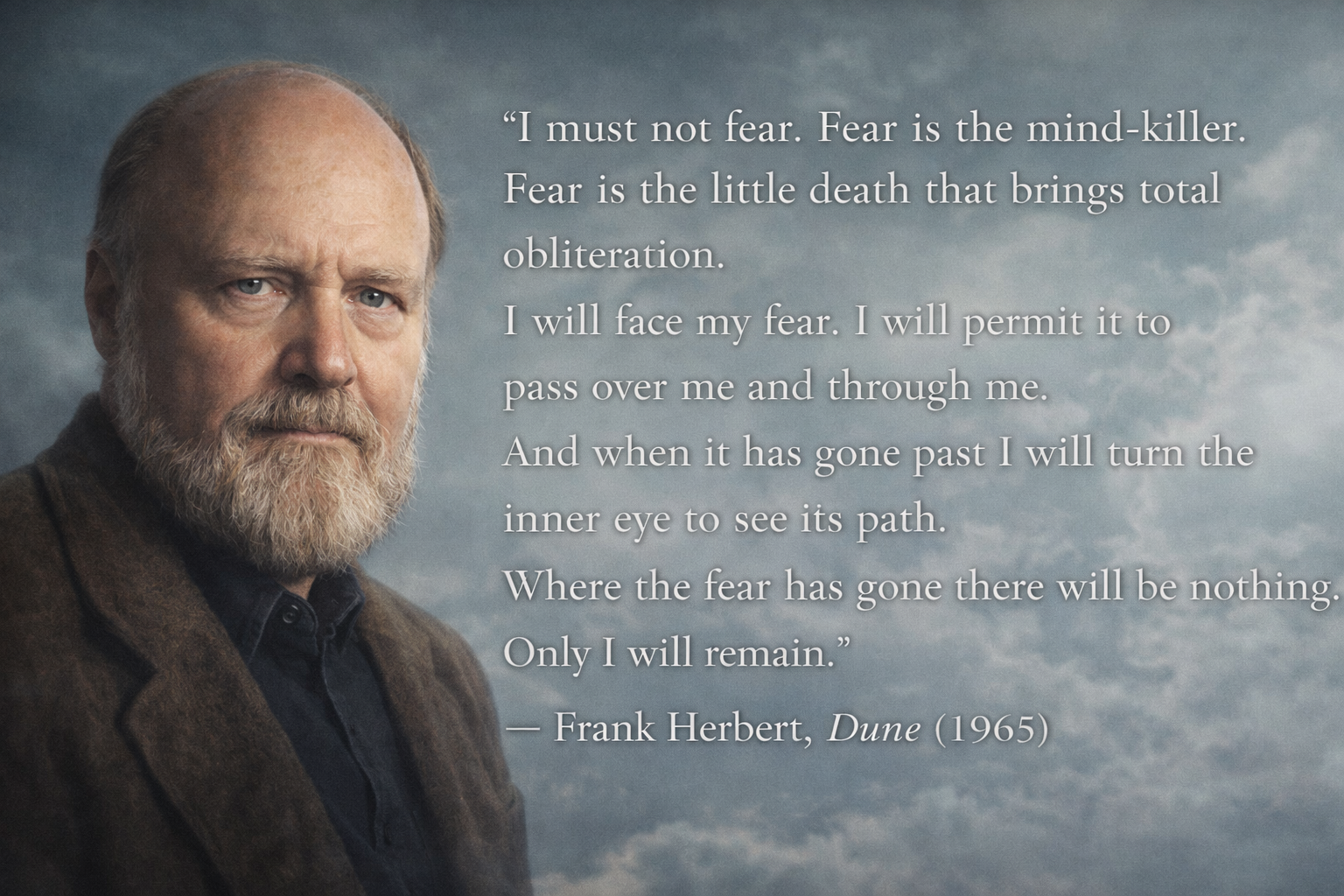
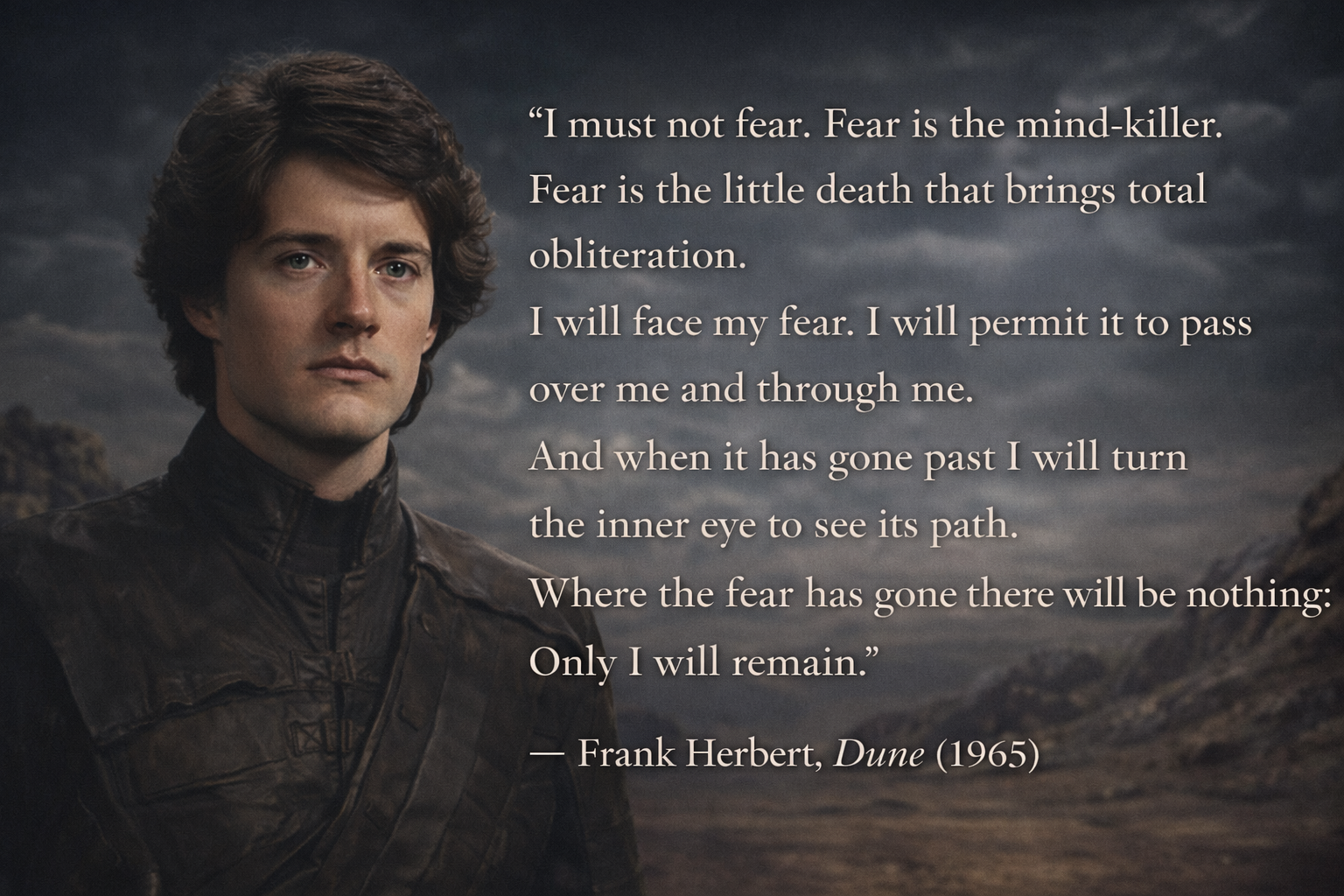
“I must not fear. Fear is the mind-killer. Fear is the little-death that brings total obliteration.
I will face my fear. I will permit it to pass over me and through me.
And when it has gone past I will turn the inner eye to see its path.
Where the fear has gone there will be nothing. Only I will remain.”

— Frank Herbert, Dune (1965)

Analytical Interpretation

Background and Context

The Litany appears in the opening chapters of Dune (1965), spoken silently by the boy Paul Atreides as the Reverend Mother Gaius Helen Mohiam holds a poisoned needle — the gom jabbar — to his neck and orders his hand into a box of pure pain. Withdraw the hand and die; endure, and prove yourself human rather than animal. Paul recites the words his mother, a member of the Bene Gesserit sisterhood, taught him. Herbert wrote in the mid-1960s, amid a rising Western appetite for Eastern contemplative practice and a Cold War preoccupation with human beings pushed past their limits. He gave the sisterhood a discipline that reads less like magic than like a rehearsed cognitive procedure — a mantra engineered to keep the mind operational when the body is screaming.

Interpretation

The Litany's power is that it is a sequence, not a sentiment. It moves through four stages, and the order is the whole argument. First, diagnosis: "Fear is the mind-killer." Herbert's precise, escalating vocabulary — mind-killer, little-death, total obliteration — reframes fear not as an emotion to be felt but as a functional threat to cognition. Fear does not merely hurt; it disables the very faculty you need to survive what you fear. Second, permission: "I will permit it to pass over me and through me." This is the paradox at the center. The Litany does not fight fear, deny it, or armor against it — it grants it passage. Resistance would be another form of being ruled by it; the reciter instead becomes porous, a channel rather than a wall. Third, observation: "I will turn the inner eye to see its path." The self splits into the one who felt the fear and the one who now studies its wake — a move modern therapists would recognize as decentering, watching the emotion instead of being fused with it. Fourth, what remains: "Only I will remain." Fear is recast as weather — something that arrives, moves through, and departs, leaving the essential self intact. The genius is that the Litany never promises the absence of fear. It promises survival of the self through fear, which is a smaller and far more achievable claim.

Current Relevance

We live inside an economy that manufactures the very thing the Litany was built to metabolize. Fear is now ambient, algorithmic, and monetized — the push alert, the doom-scroll, the outrage cycle engineered to keep the nervous system pinging. Against that, the Litany reads almost like a piece of open-source mental software: portable, repeatable, requiring no app and no subscription. Its four-stage architecture maps cleanly onto techniques that clinical psychology arrived at decades later — exposure ("I will face my fear"), acceptance rather than suppression ("permit it to pass"), and cognitive defusion ("turn the inner eye"). It has migrated out of fandom into genuine practice: people recite it before surgery, before combat deployment, before walking on stage, before saying the hard true thing. That a passage of 1960s science fiction now functions as a real coping ritual is itself the measure of how precisely Herbert diagnosed a permanent human problem.

Impact and Legacy

Few lines of genre fiction have escaped their book so completely. The Litany is quoted in self-help and performance-psychology writing, recited in meditation and martial-arts settings, tattooed, cross-stitched, and set to music; it survives translation across the Lynch and Villeneuve films and a half-century of paperback editions. Its durability is structural — the short declaratives and the rising-then-falling rhythm are built for memorization under stress, which is exactly the situation it describes. Within the Dune canon it also anchors Herbert's larger thesis that the frontier of human evolution is psychological rather than technological: the Bene Gesserit conquer not planets but their own interior states. The Litany is the most compact expression of that idea, which is likely why it, more than any plot point, is what a general reader carries away from the novel.

Contrasting Views or Controversies

The strongest objection is that the Litany models repression dressed as mastery. The Bene Gesserit are, after all, an order built on control — of emotion, of bloodlines, of politics — and a discipline that so efficiently clears fear may be teaching people to bypass a signal they ought to heed. Fear sometimes carries real information: the situation is genuinely dangerous, the decision genuinely wrong. A Jungian would warn that what is too cleanly banished tends to return unintegrated, from the shadow, with interest. There is force here — but a fair reading notes that the Litany's language is observational, not amputating: it says permit it to pass and see its path, not destroy it or feel nothing. It asks the reciter to remain conscious of the fear's trajectory, which is closer to integration than to exile. Herbert also complicates any tidy reading through Paul himself, whose disciplined ascent curdles into tyranny — a caution, threaded through the series, that mastery of the inner life is no guarantee of wisdom in the outer one.

Practical Application

The Litany works best treated as a procedure rather than a poem — run the four stages in order:

  • Individual, acute: before a high-stakes moment (medical procedure, performance, confrontation), recite it slowly to insert a deliberate gap between the spike of fear and the action taken — the pause where choice lives.
  • Individual, ongoing: as a template for any anxiety practice — name the fear, allow it without fighting, observe it as a passing event, return attention to the task. The sequence is the exercise.
  • Organizational: in training for high-consequence work (emergency response, aviation, surgery), it models the target state — not fearlessness, which is dangerous, but functional composure under fear.
  • Civic / cultural: as a diagnostic lens on a fear-saturated media environment — asking of each alarm, "is this a threat, or is it weather passing through?"

Background on the Author

Frank Herbert (1920–1986) was an American journalist and novelist whose omnivorous curiosity — ecology, psychology, comparative religion, systems of power — shaped a body of science fiction unusually dense with ideas. Dune grew from a 1957 assignment about efforts to stabilize the shifting sand dunes of the Oregon coast; the ecological problem of a hostile, water-starved landscape became the engine of the desert planet Arrakis and its people's fierce discipline. Herbert's abiding interest in how humans hold themselves together under pressure — and in the seductions and dangers of charismatic control — authorizes the Litany as more than set dressing. He was writing, throughout, about the interior work that survival demands, and the sisterhood's fear-discipline is that theme distilled to eight sentences.


Perspectives

Weather, Not a Wall

Most advice about fear tells you to conquer it, which is why most advice about fear fails — you can't win a fight against your own nervous system, and trying just adds a second fear on top of the first. What I love about Herbert's version is that it refuses the fight entirely. Permit it to pass over me and through me. You become a doorway, not a fortress. You can see a version of this at any bar near closing: the person who walked in braced against the evening, jaw set, white-knuckling the stem of the glass, and the one who let the day move through them and settle. The braced one is exhausted by ten. The porous one is still standing.

The line that undoes me, though, is the last one. Not the fear will be gone — fear always comes back, that's its job. Only I will remain. The promise isn't that you'll stop being afraid. It's that there's a you underneath the fear that the fear can't reach, and it'll still be there when the tide goes out. That's not a science-fiction spell. That's the quietest, truest thing anyone can tell you before the needle, the stage, the hard conversation: you are not the fear. You're the one it passes through.

Earlier Analytical Interpretation (2026-01-24)

[Demoted 2026-07-02 from the file's headline slot to make room for a fuller analytical read; preserved verbatim as the file's prior interpretation. Kept as the historical record, not as a current source of fact.]

Background and Context

Frank Herbert’s Dune is more than a science fiction epic—it’s a philosophical scaffolding for power, discipline, and human potential. Within this architecture lies the Litany Against Fear, recited by the Bene Gesserit as a mental defence against panic and paralysis. These women, genetically and psychologically trained across generations, represent an apex of human control. The litany is their shield—a psychological algorithm for staying present under extreme duress.

This passage is first uttered by Paul Atreides in the early chapters of the novel, as he undergoes a test that could kill him. It is more than an affirmation; it’s an invocation of inner sovereignty in the face of annihilation. As such, it echoes across the entire series—and, increasingly, outside it.

Interpretation

The Litany structures fear as a temporary illusion—a distortion that clouds the self. It begins with negation (“I must not fear”) and builds toward confrontation (“I will face my fear”) before culminating in transcendence: “Only I will remain.”

Herbert’s choice of phrasing—“mind-killer,” “little death,” “obliteration”—is precise. He defines fear as a psychological virus that corrupts clarity and erodes agency. The litany does not deny the experience of fear, but reframes it: not as something to flee, but as something to observe, endure, and outlast.

Crucially, the subject is not passive. “I will permit it to pass over me and through me.” This is not stoic detachment; it’s active mastery. The litany outlines a method: feel fear, name it, let it pass, and remain unchanged. In effect, it turns fear from a master into a transient visitor.

What remains is the self, stripped of illusion, honed by adversity.

Current Relevance

In a modern world saturated with existential threats—climate collapse, political instability, AI acceleration—the quote resonates deeply. Fear is ambient, algorithmic, and monetised. Institutions trade on it; media circulates it; systems amplify it.

The Litany Against Fear offers a counter-programming script. It speaks directly to anxiety culture: the paralysis of overexposure and uncertainty. Mental health practitioners, performance psychologists, and mindfulness advocates have all drawn parallels to its structure—a form of cognitive behavioural grounding centuries ahead of its time.

It also resonates in fields like astronautics, special operations, emergency medicine—any domain where calm must be manufactured in chaos.

Impact and Legacy

The quote has far transcended Dune. It is cited by U.S. Marines, embedded in pop culture, recited in yoga studios, and tattooed across the shoulders of more than one endurance athlete. Its rhythm lends itself to ritual; its structure to internalisation.

Herbert’s Litany has become a modern mantra—a rare piece of science fiction that migrated into real-world psychological application. It speaks to the timeless human need for inner anchoring in moments of crisis. More than a quote, it is a mental tool.

Contrasting Views or Controversies

Critics of the Bene Gesserit—and by extension, the litany—argue that it represents a hyper-controlled and emotionally repressive ethos. Their power is predicated on subjugation of instinct, on radical internal discipline bordering on suppression.

From a Jungian lens, one might ask: what is lost when fear is too quickly banished? Does mastery risk severing us from parts of ourselves that need integration, not exile?

Herbert, however, seems aware of this paradox. Paul’s journey is not one of cold control alone, but of struggle with identity, destiny, and eventual transformation. The litany is not the end of fear—but the beginning of conscious navigation through it.

Practical Application

This quote is functional philosophy.

It can be used:

  • In training environments requiring calm under stress

  • As a personal mantra during anxiety or high-stakes decision-making

  • In therapeutic settings focused on cognitive reframing

  • As a tool for visualisation before intense performance

It distills an entire emotional arc—anticipation, confrontation, resolution—into a verbal form that is repeatable and anchoring. It’s less about overcoming fear than transcending its control.

Used properly, it creates psychological space—a delay between stimulus and response—within which mastery becomes possible.

Background on the Author

Frank Herbert (1920–1986) was an American author, journalist, and ecological thinker best known for Dune, first published in 1965. With a background in philosophy, psychology, and environmental policy, Herbert brought an interdisciplinary vision to science fiction that challenged the genre’s conventions.

His work is characterised by its layered world-building, ethical ambiguity, and fascination with human potential and limits. Dune was inspired in part by Herbert’s research into sand dunes and ecology in the Oregon coast, but the novel ultimately became a platform for examining power, prophecy, and survival.

The Litany Against Fear is emblematic of Herbert’s broader vision: that human evolution is not just biological or technological—but psychological. Control begins within.
Additional Images

Provenance — researched 2026-07-02

Quote: “I must not fear. Fear is the mind-killer. Fear is the little-death that brings total obliteration. I will face my fear. I will permit it to pass over me and through me. And when it has gone past I will turn the inner eye to see its path. Where the fear has gone there will be nothing. Only I will remain.”

Attribution: Frank Herbert, Dune (1965). Authentic.

Source and context. The passage — known within the fiction and to readers as the Litany Against Fear — is a mental-discipline incantation of the Bene Gesserit sisterhood. It first appears in Book I of Dune, recited silently by the boy Paul Atreides during the gom jabbar test administered by Reverend Mother Gaius Helen Mohiam: Paul's hand is held in a box of induced pain under threat of a poisoned needle, and he steadies himself with the words taught to him by his Bene Gesserit mother, Lady Jessica. No specific real-world source for Herbert's composition is documented; secondary commentary links the sisterhood's mental techniques loosely to meditative/mantra and Jungian traditions, but that is interpretive rather than something Herbert stated.

Wording verified. The filed text matches the authorized publisher edition, with one normalization: “little death” corrected to “little-death” (hyphenated), per the authorized text — corrected in the block quote above. The clause “pass over me and through me” is correct as filed (not “past me”). The absence of a comma after “gone past” follows the authorized publisher rendering; some secondary transcriptions insert one, but the filed form is defensible and retained.

Adoption note. The Litany circulates widely as a real-world coping and performance mantra, but claims of formal institutional adoption (e.g., by the U.S. Marines) are unverified and should be treated as anecdotal. The demoted 2026-01 analytical below repeats the Marines claim as fact; it is flagged here as unconfirmed.

Citation (Chicago). Herbert, Frank. Dune. Philadelphia: Chilton Books, 1965.