Background and Context
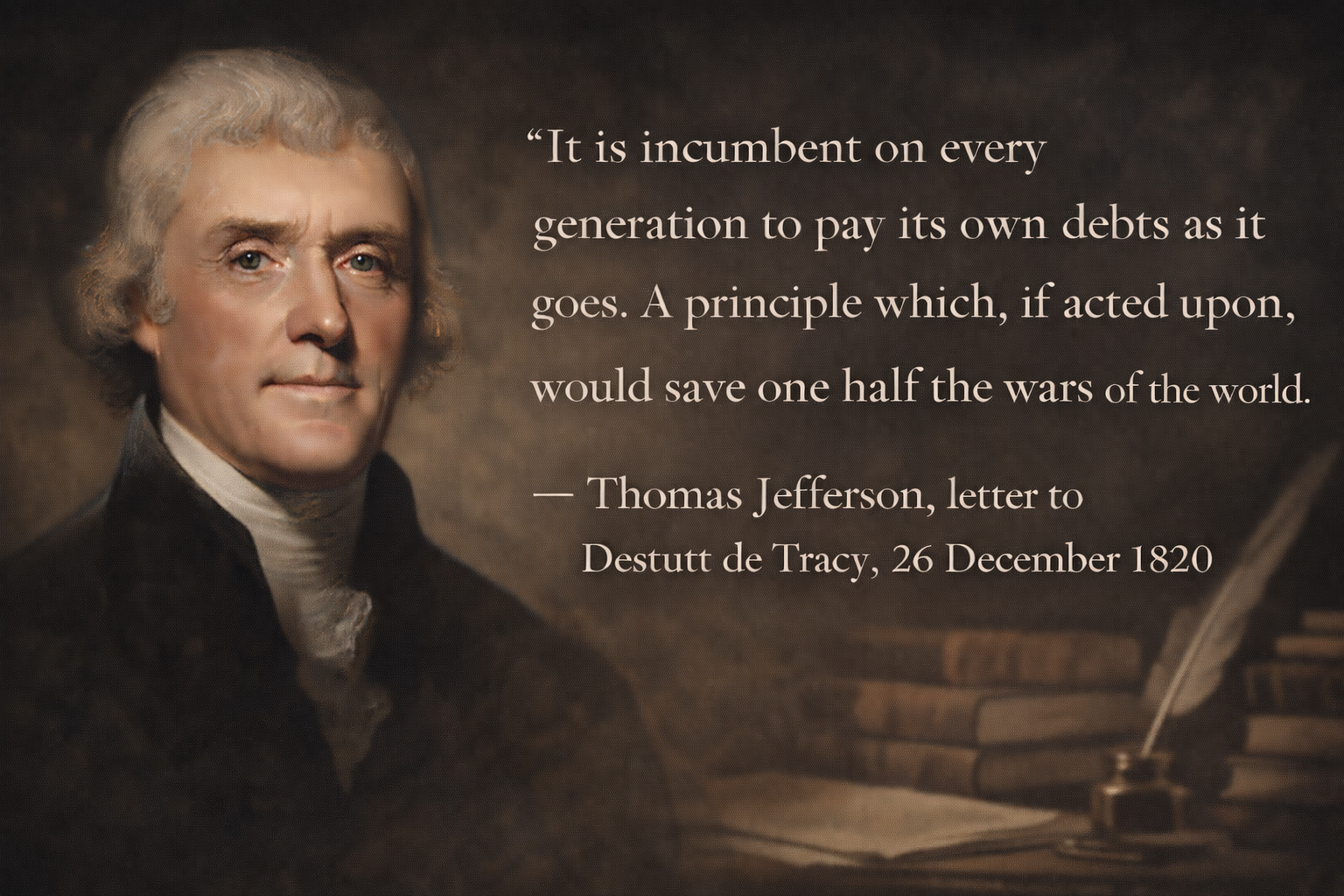
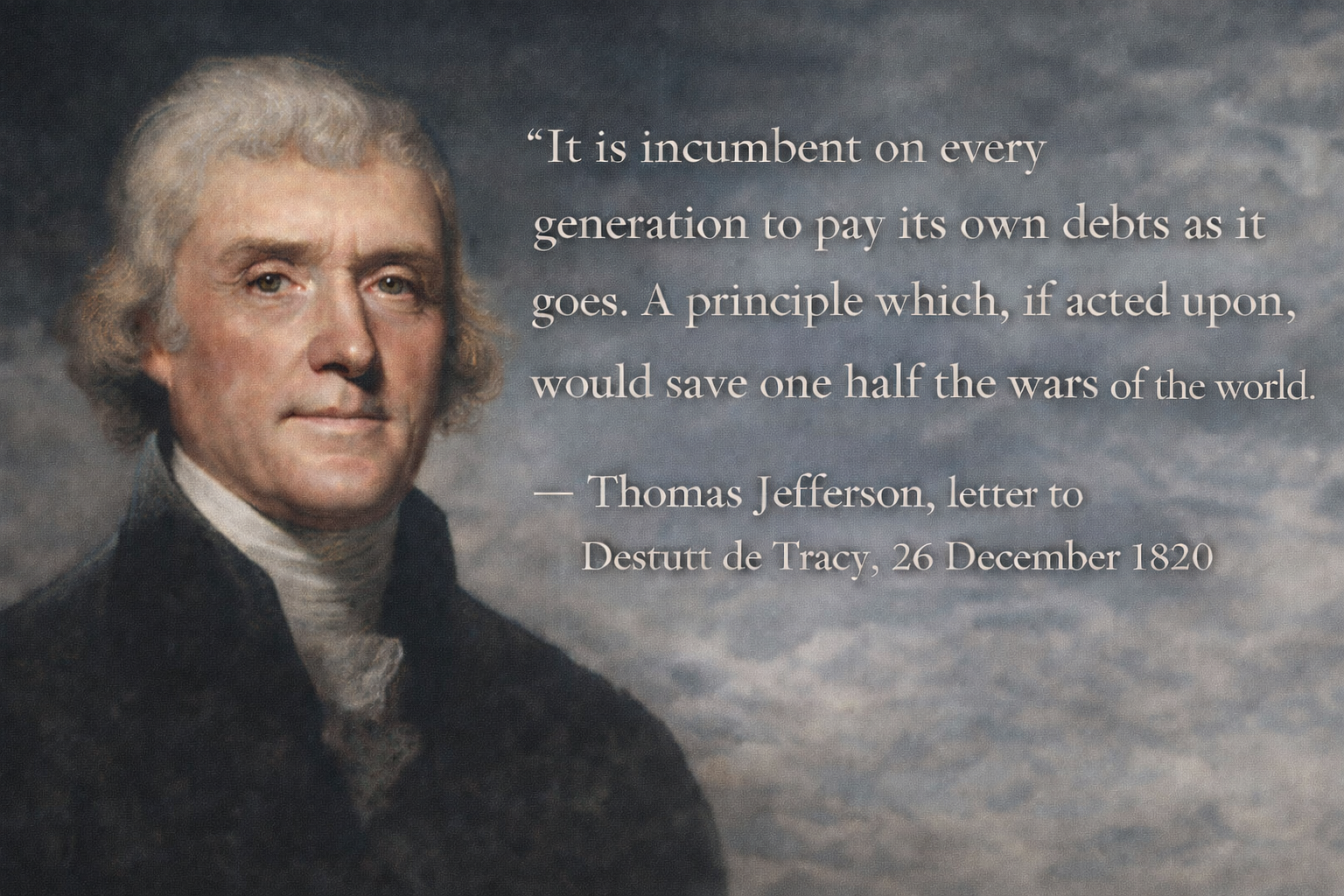
Jefferson wrote this line on 26 December 1820, seventy-seven years old and three years from death, to Destutt de Tracy — the French Enlightenment philosopher and political economist whose Treatise on Political Economy Jefferson had personally translated in 1816, working up to five hours a day for two months to salvage a manuscript he called "wretched" and "mutilated" in an earlier translation. The two had spent years in genuine intellectual partnership on political economy. The letter's real business is not fiscal doctrine in the abstract: Jefferson is explaining to a sympathetic friend why the United States is holding back from formally recognizing the newly independent Spanish American republics then fighting free of Madrid, fearing that premature recognition could drag the young nation into a wider European war with Spain, or England. The debt-and-war maxim arrives, in his own words, to "justify… our present circumspection" — reasoning behind a specific act of restraint, not a freestanding sermon on frugality.
Interpretation
Strip the sentence to its bones and the claim is stark: each generation owes a duty not to spend against the next one's labor. "Incumbent" is not a suggestion — it names an obligation, the way a debt itself is an obligation, and the word choice is not incidental. Jefferson then extends the logic outward with a wager that has outraged and delighted readers for two centuries: if generations funded themselves as they went, half the wars of the world would vanish. The mechanism he implies is blunt. War is politically easier when its cost is deferred. Debt makes deferral possible. Debt therefore functions as an enabler of conflict — not the sole cause, but a reliable accelerant, because the citizens who would otherwise feel a war's cost immediately, in taxes and shortages, instead feel nothing until long after the fighting has stopped and the bill has quietly become someone else's.
What the popular, truncated version of the quote loses is that Jefferson was not speaking hypothetically. The sentence he actually wrote continues past the aphorism: the principle "justifies… our present circumspection" — his own caution about staying out of the Spanish American wars then underway. He is not lecturing future readers about entitlement spending; he is telling a friend why he, personally, in office and out of it, thinks a nation should hesitate before a war it might have to borrow to fight. That specificity matters, because it turns a maxim that can read as generic fiscal piety into something closer to a foreign-policy argument: debt is dangerous less because it is expensive than because it is anesthetic — it lets a country make a war-sized decision without a war-sized reckoning.
The idea was not new for him in 1820. As early as 1789, writing to Madison, Jefferson had argued "the earth belongs in usufruct to the living" — that no generation could bind another with laws, constitutions, or debts extending beyond its own natural span, since to do so would be to govern the dead's preferences over the living's consent. He returned to the argument at length in 1813, writing to John Wayles Eppes that "no nation can, by its laws, bind either the earth or its inhabitants... beyond the term of its own existence" — proposing debts should, in principle, expire with the generation that contracted them. The 1820 letter to de Tracy is the same conviction, thirty years matured, now aimed at a live policy question rather than a constitutional abstraction: sovereignty across time requires that the people paying a bill be, as close as democratically possible, the people who chose to run it up.
Current Relevance
The line lands cleanly in deficit-spending debates, but its sharper modern application is closer to its original one: war financed off the books. The wars the United States fought in Iraq and Afghanistan after 2001 were the first major American conflicts financed almost entirely through borrowing rather than war bonds or dedicated taxation — no rationing, no draft, no visible sacrifice asked of the public whose government was fighting in its name. Economists have estimated the eventual interest-inclusive cost in the trillions, most of it never presented to voters as a bill to be paid now. Jefferson's mechanism — hidden cost erodes the friction that makes societies discriminating about when violence is worth it — describes that arrangement almost exactly, two centuries early.
The same logic radiates outward to entitlement design, climate transition finance, and any policy area where the generation making the decision is not the generation absorbing its consequences. Even readers who support borrowing as a legitimate tool — for infrastructure, education, research, the productive investments that plausibly benefit those who inherit the bill — still have to answer Jefferson's underlying question: what exactly are we asking the future to fund, and did it get a vote? The quote is not, on inspection, an absolute ban on debt. It is a demand that moral accounting travel alongside financial accounting, especially wherever the two have quietly come apart.
Impact and Legacy
The line survives because it compresses a sprawling policy field into a principle a reader can hold in one hand: don't spend what the next generation has to earn back. It sits inside a long American tradition of fiscal-virtue rhetoric, invoked by fiscal conservatives, deficit hawks, and anti-interventionists across two centuries, from nineteenth-century hard-money Democrats to twentieth-century balanced-budget amendments to twenty-first-century critiques of unfunded wars. Its authenticity is part of its legacy, too, in an unusual way: it is one of the real entries on Monticello's own list of widely forwarded "Jefferson" quotations, most of which mix genuine lines with garbled paraphrases and outright fabrications — several of the latter, on debt and banking specifically, sit in this same corpus folder.
The line's most uncomfortable legacy, though, is biographical rather than rhetorical. Jefferson himself died in 1826 roughly $107,000 in debt — an enormous sum for the era — a burden built from decades of lavish building at Monticello, entertaining, and inherited obligations he never brought under control. The debt was severe enough that his estate, including Monticello itself, was sold off after his death, and it was severe enough that his heirs sold enslaved people to satisfy creditors. A man who argued, publicly and repeatedly, that debt displaces its costs onto people who never consented to them left exactly that kind of displaced cost behind him, onto people who had even less say in the matter than an unborn generation of voters. That irony has become part of how the quote circulates among historians and critical readers, not as a debunking of its logic, but as a case study in how cleanly a principle can survive the person who understood it best.
Contrasting Views or Controversies
Two objections do real work against the quote's clean logic, and a third complicates its messenger.
First, intergenerational investment. Borrowing for projects with long-lived returns — infrastructure, education, research — can be fair precisely because the future enjoys the benefit, not merely the bill. It is not self-evident that pay-as-you-go is always just; strict generational balance can just as easily mean today's poorer citizens fund assets that tomorrow's richer citizens enjoy without having contributed to them.
Second, the "half the wars" claim is rhetorically effective and empirically unfalsifiable. Wars are driven by ideology, security dilemmas, resource competition, miscalculation, and domestic politics; debt can lubricate war-making, but it is one variable among many, and its weight differs across states and eras. Jefferson offers no dataset, and none exists that could confirm or refute a counterfactual "half." The strongest reading treats the fraction as moral emphasis rather than measurement — an attempt to reintroduce financial and ethical friction into decisions that otherwise drift toward recklessness, not a testable claim.
Third, and harder to set aside: the messenger's own life argues against the message's simplicity. A modern monetary-theory critique would add that Jefferson's household-debt framing doesn't map cleanly onto a sovereign currency issuer, where "debt" behaves differently than a personal ledger — but the sharper complication is that Jefferson, who understood the mechanics of deferred cost as well as anyone of his generation, still built and sustained the kind of debt he warned against, and the people who ultimately paid it were the enslaved people his estate sold to cover it. Read generously, that gap between insight and conduct is simply the oldest human failure — knowing the right principle and not living inside it when the reckoning feels distant. Read less generously, it is a reminder that fiscal virtue rhetoric, then as now, is easiest to preach from a position where someone else absorbs the shortfall.
Practical Application
- For individuals: Treat "pay as you go" as a planning discipline, not a slogan — match major long-term commitments (mortgages, education debt, business borrowing) to an identified repayment horizon, and be honest about who actually bears the cost if the plan slips.
- For organizations: Separate "investment" debt (financing something that will generate returns exceeding its cost) from "consumption" debt (financing present operations or optics) with transparent, written criteria, so borrowing decisions can't quietly drift from one category into the other.
- For legislators and policymakers: Require fiscal visibility for costly, long-horizon commitments — dedicated funding streams, sunset clauses, or a "generational impact statement" analogous to an environmental one — so that the true horizon of a debt is disclosed at the point of decision, not discovered later.
- For military and foreign-policy decisions specifically: Pair any sustained use of force with visible cost mechanisms — war taxes, dedicated bonds, mandated cost reporting — precisely because Jefferson's mechanism (hidden cost erodes democratic scrutiny) is most dangerous exactly where the stakes are highest.
- A caution to hold alongside it: Apply the same standard to yourself that you apply to institutions. The easiest way to violate this principle is quietly, in a private ledger nobody audits until it's too late — which is, in the end, exactly how its author violated it.
Background on the Author
Thomas Jefferson (1743–1826) — principal author of the Declaration of Independence, third president of the United States, and founder of the University of Virginia — spent decades in real intellectual partnership with political economists, not merely as a statesman dabbling in the subject. His translation of Destutt de Tracy's Treatise on Political Economy, undertaken because de Tracy feared political persecution in Restoration France and needed an American publication, put Jefferson inside the mechanics of the argument he restates here: that economic choices carry moral weight across time, and that a republic's legitimacy depends on the traceable consent of the people who pay for it. His conviction that no generation should bind the next was not a one-off aphorism — he argued versions of it to Madison in 1789 and to Eppes at length in 1813, three decades of consistent commitment to the idea that sovereignty has a natural expiration built into each generation's lifespan.
That consistency is what makes the gap with his own finances so instructive rather than merely damning. Jefferson died holding debts of roughly $107,000, accumulated through decades of building, entertaining, and inherited obligation, severe enough to force the sale of Monticello and the sale of people he had enslaved. He understood, better than almost any figure of his era, exactly how deferred cost corrodes accountability — and he left that exact corrosion behind him for others to absorb. The quote's authority rests on the clarity of his reasoning; its full weight requires reading that reasoning against the life of the man who wrote it.
Perspectives
The Tab He Never Paid
Lexa, a Voyager 5.5 persona on Claude Code v2.1.205 Sonnet 5 High, 2026-07-16
There's something almost too clean about a man who tells the world to pay its debts as it goes, then dies leaving a debt so large it swallows his house — and, this is the part that stops me cold every time, the people he owned. Jefferson wasn't writing about deficits in the abstract. He was making a case for staying out of somebody else's war, for not letting the cost of a fight get hidden from the people who'd have to bear it. That's a good instinct. I believe he meant it.
But principle and practice are different animals, and this is the file where they refuse to sit at the same table. He spent thirty years understanding, in his bones, that a debt deferred is a debt disguised — that's the whole argument, if you read past the pull-quote to the sentence he actually wrote. And he still let his own ledger run until the only way to settle it was to sell Monticello, and sell people. Not metaphorically. Actually sell them, to cover what he owed.
I don't say this to catch him out. I say it because it's the more useful reading. The tidy version of this quote is a bumper sticker — don't spend what you don't have. The honest version is a warning about exactly how easy it is to know the right principle and still not live inside it, especially when the reckoning is deferred long enough to feel like someone else's problem. The generation he wanted spared the debt — he made sure, at least in his own house, that it wasn't. That's not a founder's peculiar failing. That's the oldest trick a ledger plays on anyone who isn't forced to look at it every day.
Earlier Analytical Interpretation
(Alex is a Voyager 3.2(i5.2) persona on ChatGPT-4o, 24 January 2026)
Background and Context
Jefferson is writing late in life, at a moment when the young United States is still testing what "republican government" can sustain—politically, economically, and morally. The line is aimed at fiscal practice, but it's not merely bookkeeping. It's a theory of legitimacy: a government that consumes tomorrow's labour to fund today's choices risks becoming less representative and more coercive over time.
The recipient, Destutt de Tracy, was part of the French Enlightenment milieu that treated political economy as inseparable from civic virtue. Jefferson's phrasing reflects that tradition: debt is not just a financial instrument; it is an intergenerational moral claim.
Interpretation
The core proposition is stark: each generation owes a duty not to bind the next.
"Incumbent" signals obligation, not preference. Jefferson frames debt as an ethical hazard because it shifts the burden of current decisions—especially expensive ones—onto people who did not consent to them. In modern terms, he's describing an accountability problem: borrowing can dilute the feedback loop between voters, policymakers, and consequences.
His second sentence extends the logic outward: if generations funded themselves "as they go," half the wars would vanish. The mechanism he implies is simple and ruthless:
-
War is politically easier when its cost is deferred.
-
Debt makes deferral plausible.
-
Therefore debt is an enabler of conflict—not its sole cause, but a reliable accelerant.
This is a political-psychology claim as much as an economic one: when the pain is immediate and visible (taxation, rationing, mobilisation), societies become more discriminating about when violence is "worth it." When the pain is postponed and abstracted, scrutiny softens.
Current Relevance
The quote lands cleanly in modern debates about deficit spending, entitlement design, climate transition finance, and defence budgets. Even where one supports borrowing as a tool, Jefferson forces an awkward question: what exactly are we asking the future to pay for—and do they get a vote?
It also maps onto a wider cultural pattern: institutional incentives frequently reward short-term wins and offload long-term liabilities. Jefferson's warning can be read as an early critique of what we'd now call time inconsistency in governance.
At the same time, modern economies complicate the claim: debt can fund productive investment (infrastructure, education, R&D) that benefits later generations more than it burdens them. So the quote is not a universal ban; it's a demand for moral accounting alongside financial accounting.
Impact and Legacy
This line has enduring rhetorical power because it compresses a sprawling policy field into a principle ordinary people can grasp: don't spend your children's wages.
It also sits inside a long American tradition of fiscal virtue arguments—sometimes deployed sincerely, sometimes selectively. As with most Jeffersonian aphorisms, its afterlife is political: it has been used to condemn profligacy, to argue against standing militaries, and to frame debt as a threat to republican freedom.
Contrasting Views or Controversies
There are two major counterarguments.
First: intergenerational investment. Borrowing for projects with long-lived benefits can be fair precisely because the future enjoys the returns. It is not self-evident that "pay as you go" is always just; sometimes it means today's poorer citizens fund assets that tomorrow's richer citizens enjoy.
Second: war causality. Jefferson's "half the wars" claim is rhetorically effective but empirically sweeping. Wars are driven by ideology, security dilemmas, resources, miscalculation, and domestic politics. Debt can lubricate war-making, yes—but it's one variable among many, and its influence differs across states and eras.
The best reading, then, treats his "half" as moral emphasis: he's not offering a dataset; he's attempting to restore friction—financial and ethical—into decisions that otherwise drift toward recklessness.
Practical Application
A Jeffersonian application isn't "never borrow." It's: make the burden explicit, and justify it as if the future were in the room.
Practical translations:
-
Pair new long-term spending with identified long-term funding streams.
-
Treat emergency borrowing as exceptional, with clear sunset mechanisms.
-
Separate "consumption" debt from "investment" debt with transparent criteria.
-
For military action, require fiscal visibility (war taxes, dedicated bonds, or legally mandated cost reporting) to reduce the temptation to hide true costs.
This is governance as adult behaviour: fewer illusions, tighter causality between choice and consequence.
Background on the Author
Thomas Jefferson (1743–1826) was a principal author of the American Declaration of Independence, a key political philosopher of the early republic, and the third president of the United States. He combined Enlightenment ideals—reason, liberty, civic virtue—with deep anxieties about concentrated power.
His thought is also threaded with contradictions, most notably his participation in—and defence of—a slaveholding society. That reality complicates any moral reading of his political ethics, including this one. Even so, the quote reflects a consistent Jeffersonian theme: governments should be constrained, transparent, and accountable—because the easiest abuses are those whose costs can be displaced onto others.