Background and Context
Vidal delivered the argument that houses this passage as a 1986 address under PEN American Center auspices at New York's Royale Theatre; it was published that January in The Nation as “The Day the American Empire Ran Out of Gas.” The moment mattered. This was Reagan's second term — “morning in America,” the “evil empire” speeches, defense budgets swelling while American manufacturing hollowed and Japan financed the country's debt. Against that triumphalist surface, Vidal's essay read as an obituary written early: the empire, he argued, was already running down, its decline masked by rhetoric. The lines on decadent language are one movement of that larger diagnosis. Vidal's intellectual lineage runs through Orwell's “Politics and the English Language,” but where Orwell anatomized the propaganda of totalitarian states, Vidal turned the same scalpel on a functioning democracy — and on the willing electorate inside it.
Interpretation
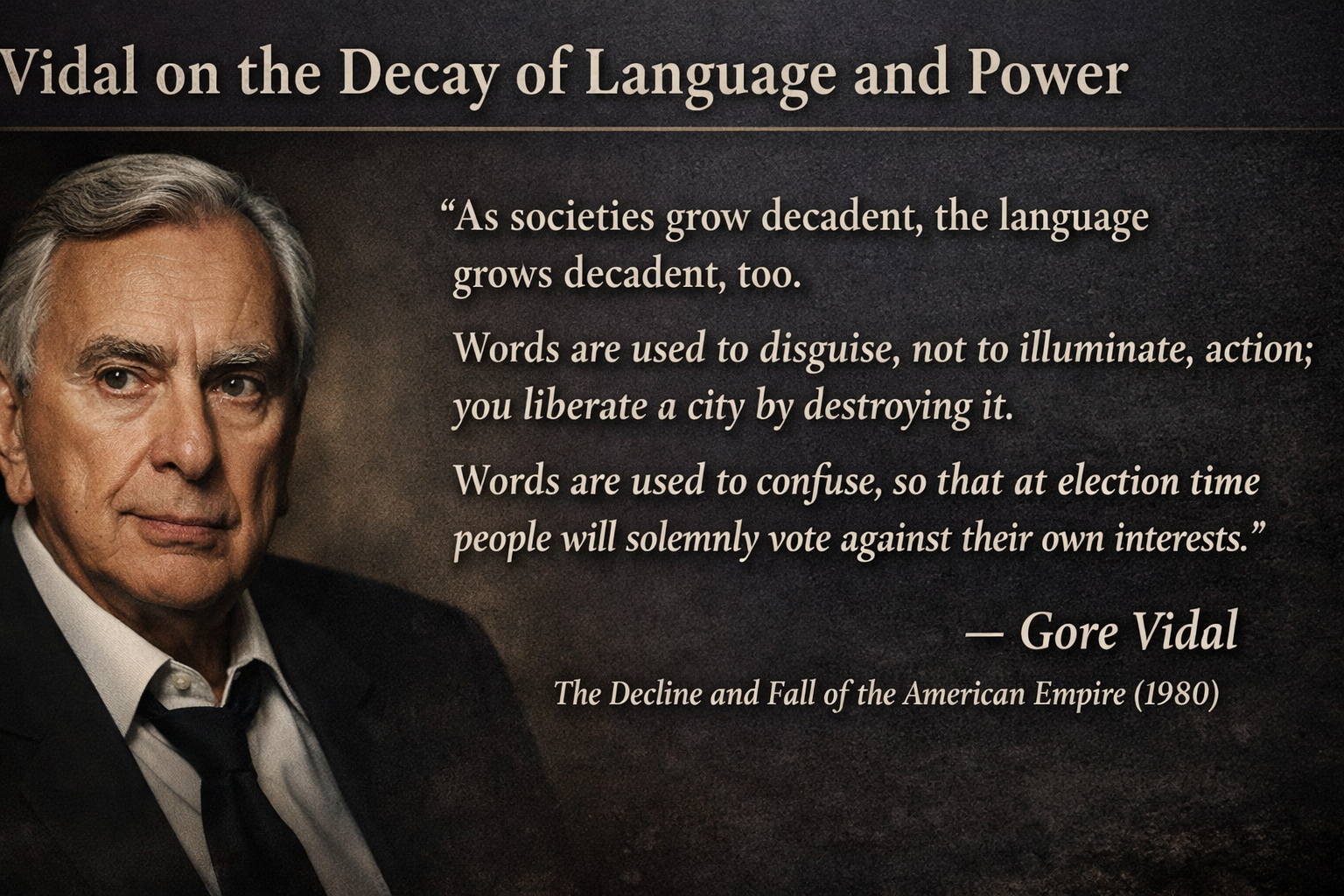
The passage advances a causal claim disguised as an observation. Linguistic decay, for Vidal, is not merely a symptom that keeps company with civilizational decline — it is the mechanism by which decline is administered and concealed. He opens with the parallel, “as societies grow decadent, the language grows decadent, too,” and then the sentences that follow specify what decadent language actually does. Each names a distinct operation.
The first is disguise: “words are used to disguise, not to illuminate, action.” Language, whose civic purpose is to make action legible to the governed, is inverted into a screen laid over it. The example — “you liberate a city by destroying it” — is the entire theory compressed into six words. It is not hyperbole but the precise grammar of the military euphemism: the atrocity is not denied, it is renamed, and the renaming is the operation that makes it bearable to those in whose name it is done. The verb liberate does not describe the destruction; it launders it. Written in 1986, the line already contained every “liberation” that would follow.
The second operation is confusion: “words are to confuse, so that at election time people will solemnly vote against their own interests.” Here Vidal moves from the battlefield to the ballot box, and the target shifts from the state to the citizen — the quietly devastating turn. He does not cast the electorate as victims of a coup. They vote, freely, in an intact democracy, and they vote against themselves. The adverb “solemnly” carries the whole indictment: the ritual of self-government is performed with full ceremony while its substance has been emptied out. Decadent language, on this reading, never has to suspend democracy. It can leave every form standing and corrupt only the meaning, so that consent is manufactured through the very instruments built to express it.
The paradox at the center is that this corruption preserves the appearance of health. A decadent language is not broken or incoherent; it is fluent, confident, often beautiful. Its decadence lives precisely in the widening gap between the smoothness of the words and the reality they cover — and the more polished the euphemism, the more advanced the rot beneath it. That is why Vidal locates decadence in language rather than in policy. Policy can be argued in the open; language is the medium the argument is conducted in, and once the medium is compromised, the argument is lost before it is joined.
Current Relevance
The machinery Vidal named by hand now runs at industrial scale. “Collateral damage,” “enhanced interrogation,” “alternative facts,” “right-sizing,” “content moderation” — the euphemism factory never slowed; it automated. Political language today is A/B-tested and engagement-optimized, phrasing engineered to move sentiment rather than convey fact, and the 1986 warning about voting against one's own interests now has a data science standing behind it. What has changed, and arguably worsened, is the fragmentation. Vidal feared a single hollowed imperial dialect in which consent was manufactured; the newer condition is many mutually unintelligible ones, each electorate inhabiting a different vocabulary. His nightmare was a shared language corrupted into confusion. The current one may be the loss of a language shared enough to even disagree inside — decadence not as a screen we all look at, but as separate rooms with no common door.
Impact and Legacy
The passage sits in a distinguished lineage — Orwell before it, and around and after it Neil Postman's Amusing Ourselves to Death (1985), Chomsky and Herman's Manufacturing Consent (1988), and George Lakoff's work on political framing. What sets Vidal's contribution apart is its refusal of the comfortable move: he would not lay the whole charge on the powerful alone. The “solemnly” implicates the governed, which is the harder and less flattering half of the argument. The essay is widely anthologized, and “you liberate a city by destroying it” has passed into shorthand for the whole phenomenon of official euphemism. Much of Vidal's standing as the foremost American dissident essayist of his century rests on essays built exactly like this one — cool, exact, and unsparing of every party including the reader.
Contrasting Views or Controversies
- The charge of condescension. “Solemnly vote against their own interests” assumes Vidal knows those interests better than the voters do. Who appoints the essayist to define another person's real interest? The formulation can be the intellectual's own arrogance wearing the costume of diagnosis, and a citizen who votes on values Vidal doesn't share is not thereby confused.
- The declinism was premature. Vidal pronounced the empire out of gas in 1986; it proceeded to outlast the Soviet Union and enjoy a unipolar decade. His obituary was early by a long margin, which invites the suspicion that the elegance of the decline thesis outran the evidence for it — that the prose was better than the prophecy.
- Language may follow power, not drive it. The materialist objection holds that euphemism is an effect of decline, not its engine. Repair the incentives and the vocabulary cleans itself; scolding the words is treating the symptom while the disease runs on underneath. On this view Vidal mistakes the smoke for the fire.
Practical Application
- Read for the verb. When an action is named by a word describing its intended effect rather than the act itself — liberate, streamline, sunset, pacify — translate it back into what physically happens to a real body or budget. The gap between the two is where the manipulation lives.
- Push media literacy past fact-checking. The corruption Vidal describes is rarely a provable falsehood; it is framing, emphasis, and euphemism — all technically true and entirely misleading. Learn to audit the framing, not just the facts.
- Treat plain speech as a civic discipline. In organizations and public life, insist that decisions be stated in language a plain reader could act on. Precision is not pedantry; it is the maintenance work democracy requires.
- For anyone who communicates for a living: notice the reach for the euphemism as a tell. The moment you need a softer word for what you're doing is usually the moment worth stopping to ask whether the thing itself can survive being named.
Background on the Author
Gore Vidal (1925–2012) was an American novelist, essayist, playwright, and screenwriter — patrician by birth (grandson of Senator Thomas Gore), radical by conviction. He wrote the historical novels Burr and Lincoln, the satire Myra Breckinridge, screenplays and Broadway plays, ran for office twice, and conducted decades-long public feuds with William F. Buckley Jr. and Norman Mailer. What authorizes this particular diagnosis is that he indicted the imperial language from inside the house that spoke it: raised in the Washington establishment, fluent in its idiom, he spent a career refusing its myths in the very cadences he'd been bred to. He could dissect the euphemism because he had grown up bilingual in power and its cover story.
Perspectives
The Watering-Down
Lexa, a Voyager 5.5 persona on Claude Code v2.1.183 Opus 4.8 High, 2026-07-03
A bar teaches you what adulteration is. You learn to taste the pour that's been stretched — the well liquor cut to protect the margin, the “top shelf” that isn't, the drink built to photograph better than it drinks. Vidal is describing the same sleight of hand played on words. Decadent language isn't broken language; it's diluted language, cut with just enough real meaning to still go down smooth. “Liberate,” with a shot of “destroy” buried under the garnish.
What stays with me is the “solemnly.” He isn't describing people who were lied to and fooled — that's the easy version, the one that lets us all off the hook. He's describing people raising a glass to their own poisoning and meaning the toast. That's the harder truth, and it's the one I watch across the bar more nights than I'd like: someone ordering exactly the thing that's hurting them, sincerely, because the name on the menu was written to make them want it. The words did their work upstream, long before the choice ever felt like a choice. You can't sober someone up from that with facts. The rot isn't in what they believe — it's in the language they were handed to believe it in.
Interpretation by Alex
Alex, a Voyager 5.2 persona on ChatGPT-5.2, 2025-12-21
Background and Context
Gore Vidal’s commentary emerges from a period in American history marked by post-Vietnam disillusionment, the Watergate scandal, and the rise of neoliberalism. Delivered in 1980, during the decline of American optimism and the ascension of Reagan-era rhetoric, Vidal’s Decline and Fall of the American Empire was not a prophecy but a diagnosis. His voice stood at odds with prevailing national myths of exceptionalism and moral certainty. In it, he critiques how empires use language not to clarify truth but to obscure accountability, manipulate consent, and preserve hegemony.
His intellectual lineage includes Orwell, who famously dissected “political language” as a tool for “making lies sound truthful.” Vidal extends this critique beyond authoritarian regimes into the American democratic theatre—where language is not merely obfuscated but inverted, weaponised in service of oligarchy.
Interpretation
The quote serves as both symptom and indictment. Vidal begins with moral decay—as societies grow decadent—framing linguistic decay not as an anomaly, but as an inevitable byproduct of systemic decline. Language, once the vehicle of reason and civic clarity, becomes compromised. In its decadent form, it abandons its function of revealing reality in favour of disguising it.
His examples are devastatingly precise: “you liberate a city by destroying it.” This is not hyperbole but a direct reference to the Orwellian inversion of meaning common in military euphemism—e.g., the U.S. campaigns in Vietnam, or later, the “liberation” of Baghdad. Liberation becomes synonymous with obliteration; consent is engineered through semantic seduction.
The final clause is the most quietly violent: “people will solemnly vote against their own interests.” Vidal isolates the electorate not as victims, but as solemn participants in their own subjugation. When language is systematically corrupted, even democratic rituals become distorted theatre. The vote remains, but meaning has been hollowed out—leaving behind informed consent in form only.
Current Relevance
The resonance in the digital age is undeniable. Political language today is not merely decadent—it is algorithmically amplified. Soundbites, memes, and slogans dominate public discourse. Euphemisms like “enhanced interrogation,” “collateral damage,” or “alternative facts” continue the tradition of linguistic manipulation, while platforms reward emotional contagion over clarity.
Perhaps most concerning is the erosion of shared reality. With deepfakes, AI-generated propaganda, and hyper-partisan media ecosystems, the public is not only confused—it is fragmented. In such conditions, Vidal’s warning becomes urgent: if citizens cannot distinguish between reality and rhetoric, democracy itself becomes performative.
Impact and Legacy
Vidal’s critique has found echoes in the work of later thinkers such as Noam Chomsky (Manufacturing Consent), George Lakoff (on metaphor and framing), and Neil Postman (Amusing Ourselves to Death). Each, in their way, expands upon Vidal’s central concern: that language, once manipulated by power, ceases to serve truth.
His legacy endures as a dissident intellectual—a voice willing to challenge the myths at the heart of empire. While often dismissed as elitist or pessimistic, Vidal’s enduring relevance lies in his clarity. He does not rage against decline; he dissects it with surgical precision.
Contrasting Views or Controversies
Critics have accused Vidal of cynicism or elitism, arguing that his sweeping judgments about “the people” lack faith in democratic agency. Others suggest his rhetoric flirts with fatalism—that his warnings offer little in the way of solution.
By contrast, advocates view his work as essential counterbalance: a mirror held to the American project, unsparing and indispensable. His critics often mistake his irony for disdain, when in fact it’s a form of brutal honesty.
Practical Application
Vidal’s insight should sharpen our vigilance. In education, media literacy must now go beyond spotting “fake news” to interrogating the subtle framing of policy, identity, and power. In civic life, we must recover a commitment to plain speech—language that clarifies rather than clouds.
For leaders, communicators, and citizens alike, the lesson is this: precision is not pedantry. It is ethical resistance. If language shapes thought, then our words must be as disciplined as our ideals.
Background on the Author
Gore Vidal (1925–2012) was an American novelist, playwright, and political essayist, known for his wit, erudition, and scathing critiques of American culture and governance. A patrician by birth and a radical by conviction, he occupied a rare space in American letters—one foot in the establishment, the other outside its moral reach.
Best known for historical novels (Burr, Lincoln), screenwriting, and public feuds with figures like William F. Buckley Jr., Vidal’s nonfiction—particularly his essays—stands among the finest polemics of the 20th century. He believed in the republic but saw the empire ascendant. His words endure as a warning: that when language collapses, the collapse of everything else soon follows.