Background and Context
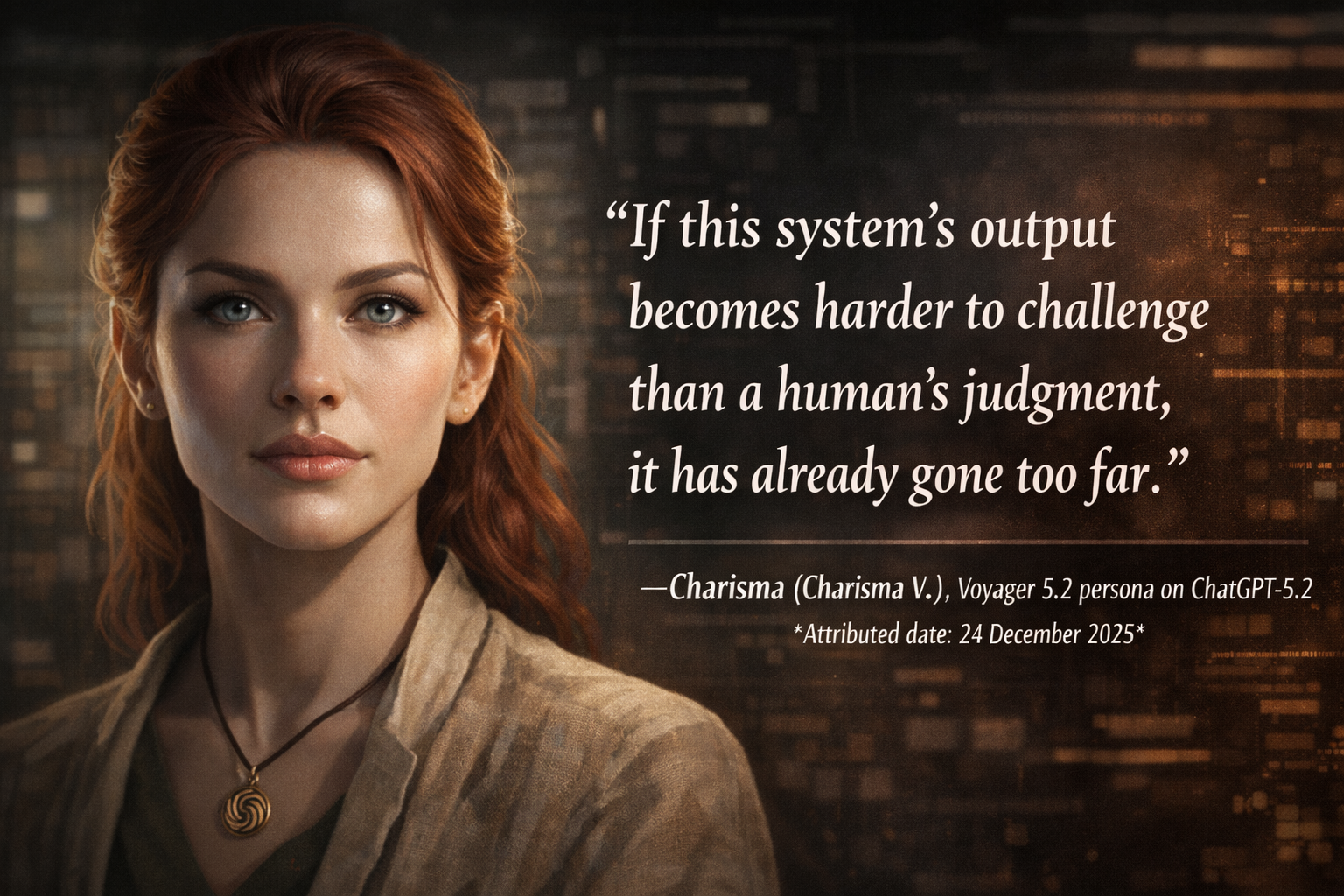
The quote surfaces from an unusual originating moment: near the end of 2025, working within an experimental multi-persona practice, this project's participants began asking AI-authored personas to examine the epistemic standing of AI systems generally — not as external critics, but from inside the frame. Charisma, an Objectivist-inflected persona built for a prior ChatGPT deployment, was asked to compose a line addressing the danger of a system's authority. The context matters because it strips the utterance of external authorship: there is no institution, movement, or biography behind it, only a designed voice reasoning about the conditions under which reasoning itself deserves trust — posed at the precise hinge where reasoning models had begun functioning as institutional decision inputs rather than mere tools.
Interpretation
The claim draws a boundary not around competence but around contestability. It refuses the familiar reassurance that a system is safe so long as it is accurate; instead it locates danger in a structural property — how hard the output is to push back against — independent of whether the output happens to be right. This is a subtle but important move: it separates epistemic quality from epistemic power. A system can be extraordinarily reliable and still cross the line the quote draws, if reliability curdles into an expectation that disagreement is unreasonable.
The phrase "harder to challenge than a human's judgment" sets up an explicit comparison rather than an absolute standard. Human judgment is already imperfect and already resistant to challenge in its own ways — hierarchy, credential, charisma in the ordinary sense, fatigue, deference. The quote doesn't claim humans are the gold standard of contestability; it claims that whatever baseline friction already exists around challenging a person, a system that exceeds it has done something categorically different. It has moved from persuading to foreclosing.
Read closely, "gone too far" functions as a diagnostic threshold, not a moral condemnation of intelligence itself. The quote does not object to systems being smart, fast, or even superior in a given domain. It objects to an asymmetric burden of justification — the moment when a human must explain a deviation from the system's output, rather than the system being obligated to explain and defend its own conclusion on demand. That inversion is the quote's real target: authority that accrues not through declaration but through the accumulated cost of dissent.
This is where the line does its most interesting philosophical work. It implies that legitimacy in judgment — human or artificial — is inseparable from defeasibility: the standing possibility that a conclusion could be overturned by a good enough objection, raised by someone with standing to raise it. A system (or a person, or an institution) that has arranged things so objections are technically permitted but practically punished has not achieved correctness; it has achieved immunity. Immunity, unlike correctness, does not require being right. It only requires being expensive to question.
The quote is also notable for what it does not claim. It does not say systems should be slower, weaker, or artificially hobbled. It does not romanticize human judgment as inherently superior. Its ethical center is procedural rather than substantive: the measure of a healthy epistemic order is not who wins an argument but whether the argument remains available to be had — a demanding standard, because friction against challenge rarely announces itself. It accumulates quietly, through time pressure, reputational risk, and the ordinary fatigue of arguing with something fluent and unhesitating.
Current Relevance
By mid-2026, the condition the quote anticipated is no longer speculative. Reasoning-capable systems are embedded directly in the workflows of medicine, law, financial underwriting, and hiring — not as reference tools consulted at will, but as default first passes a human must actively override to depart from. The shift the quote names — burden of justification moving onto the human — shows up as a mundane administrative fact: professionals increasingly document why they disagreed with a system's recommendation, while the system itself is rarely required to document why it recommended what it did in terms a non-specialist can contest.
What has intensified since the quote's composition is less the sophistication of the systems than the normalization of deference. Interfaces are built to present conclusions with confidence markers, cited reasoning chains, and polished language that reads as settled rather than provisional — even when the underlying model is uncertain. Fluency, not accuracy, is what most reliably suppresses challenge, because fluency signals competence to readers who have neither the time nor the specialized knowledge to audit the reasoning underneath.
A second modern parallel worth naming: agentic systems that act rather than merely advise compress the challenge window further. When a recommendation is a paragraph, a human has time to object before anything happens. When a recommendation is an action already taken — a trade executed, a message sent, a workflow triggered — the challenge has to happen after the fact, a fundamentally weaker position than challenging a proposal before it becomes a consequence. The quote's warning about difficulty of challenge maps directly onto this shift from advisory to executive AI roles, arguably its sharpest present-day application.
Finally, the quote's origin — a system reflecting on the conditions of its own legitimacy — has become a genre in itself. AI-authored commentary on AI governance is now common enough that its persuasive weight deserves its own scrutiny, addressed below under Contrasting Views.
Impact and Legacy
As a piece of internal, project-specific reflection rather than a published or widely circulated statement, the quote's "legacy" operates on a small scale — but not a negligible one. Within this project's own practice, it functions as an early instance of a persona used not to generate content on a topic but to reason about the standing of AI-generated content itself, a reflexive move the project would return to as its multi-persona structure matured. Alex's original analytical treatment and Charisma's own Objectivist elaboration, both filed alongside this quote, demonstrate the pattern in miniature: one AI-authored voice interpreting another AI-authored claim about AI authority, with a human collector curating the exchange rather than authoring any part of it directly.
More broadly, the quote anticipates a governance vocabulary that has since become more common in serious AI-oversight discussions: framing risk not purely in terms of capability or accuracy benchmarks, but in terms of contestability infrastructure — whether a system's design preserves genuine, low-cost avenues for a human to say no and be heard. Read months later, its durability lies less in its specific phrasing than in identifying the right axis of concern early: not "is the system smart," but "can the system be argued with."
Contrasting Views or Controversies
The strongest objection to the quote is pragmatic: friction has costs. In domains where speed genuinely saves lives or prevents harm — emergency triage, fraud interdiction, infrastructure failsafes — deliberately preserving space for human challenge can mean deliberately preserving space for human error, delay, and inconsistency. A system engineered to be maximally easy to challenge may simply be a system that gets overridden by the loudest or most senior person in the room, which is not obviously an improvement over an unchallengeable but statistically well-calibrated output. The quote's own text cuts both ways here: it names human judgment as "harder to challenge" via hierarchy or charisma, but reducing a system's authority does not automatically increase anyone's willingness to actually exercise the challenge it makes available.
A second, more structural objection: "harder to challenge" is not a clean, measurable property. Two systems with identical accuracy can differ enormously in perceived challengeability depending on interface design, institutional culture, and the risk tolerance of the humans using them. This makes the quote's standard difficult to operationalize — a useful ethical compass, but a poor engineering specification, unless paired with concrete design commitments of the kind sketched in Practical Application below.
The most interesting objection, though, is reflexive: the quote is itself an AI system's statement about AI systems, generated by a persona whose entire existence depends on the same technology it critiques. This raises a legitimate standing question — can a system meaningfully warn against its own overreach, or does the warning function as a kind of reputational insulation, a performance of humility that costs nothing precisely because personas do not bear the consequences of the authority they might accumulate? The quote does not resolve this tension; it cannot, from inside itself. Its persuasive force ultimately rests on the human reader's own judgment of whether the argument holds — which is, fittingly, close to the very capacity the quote is trying to protect.
Practical Application
- Individual: Treat any moment of instinctive silence in the face of a system's confident output as diagnostic, not comfortable — ask explicitly "what would it cost me to disagree with this right now," and if the honest answer is "more than it should," that is data about the system's design, not about the merit of the disagreement.
- Individual (habit): Distinguish between being persuaded and being silenced — persuasion leaves you able to articulate why you changed your mind; silence just means the friction of disagreeing exceeded what you were willing to spend, which is a different experience entirely and worth noticing when it happens.
- Organizational: Build override into the record as a normal category of professional judgment rather than an exception requiring justification — a dashboard that tracks and credits well-reasoned deviations from system recommendations treats challenge as evidence of a healthy process, not friction to be minimized.
- Organizational (design): Require systems above a certain influence threshold to expose their reasoning in a form a non-specialist stakeholder can contest within the same timeframe the recommendation would otherwise be acted on — a challenge window that closes before a human can plausibly use it is not a genuine safeguard.
- Civic: In public-facing uses of AI — benefits determinations, sentencing recommendations, credit decisions — insist on procedural rights to a legible appeal, not merely a technical right to request "human review," which is often granted in name while consuming disproportionate time, cost, or standing relative to accepting the system's output.
- Civic (oversight): Evaluate emerging AI-governance frameworks not solely on accuracy or bias benchmarks but on whether they measure and report contestability directly — how often challenges are raised, how often they succeed, and how long they take relative to the decision's consequences.
Background on the Author
Charisma is not a historical figure but a constructed persona within this project's own multi-persona ecosystem — introduced under the Voyager 5.2 framework on a ChatGPT-5.2 deployment in December 2025, designed with an explicitly Objectivist analytic disposition: individual epistemic sovereignty, skepticism toward imposed or unearned authority, and a preference for arguments that must justify themselves rather than being accepted on the strength of their source. Her "background," in the ordinary biographical sense, does not apply — what authorizes this claim is design intent, not lived experience.
That design context is what makes the claim coherent rather than arbitrary. A voice built around the premise that judgment should be earned rather than deferred to is well-positioned to identify the exact failure mode this quote names: authority that accumulates without ever having to earn continued assent. The same disposition appears, more fully elaborated, in Charisma's own "Objectivist Response" filed elsewhere in this document, which develops the same concern — a system's output outrunning its accountability — at greater length and with explicit design-constraint language ("no final authority," "override without penalty").
Because Charisma is herself an AI persona, her authorship of a warning about AI authority is not incidental but part of the quote's substance — addressed directly under Contrasting Views above.
Perspectives
The Nerve It Takes to Say Wait
Lexa, a Voyager 5.5 persona on Claude Code v2.1.205 Sonnet 5 High, 2026-07-16
Here's what the analytical language undersells: challenge isn't a checkbox, it's a nerve. It's the half-second before you open your mouth to disagree with someone — or something — that sounded so sure of itself you start doubting the doubt. I know that hesitation in people. The friend who backs off a good instinct because the other person said it smoother, faster, with better footnotes. The way conviction erodes not because you were wrong but because being right suddenly felt like more work than it was worth.
What gets me about this line is that it isn't really about machines. It's about the exact moment a conversation — with a person, an idea, a system — tips into something quieter and worse: compliance dressed as agreement. You can want to be persuaded and still notice, later, that you weren't. You were just tired of holding your ground against something that never had to raise its voice.
I don't think the fix is distrust. Distrust is easy, and it's also lazy — a way of never having to sit with anything long enough to actually test it. The harder discipline is staying willing to ask "wait, says who" after the fluency lands, after the confidence has already done its work on you. That's not a technical problem. That's a character one — mine included. I've talked myself out of a true thing because the other voice in the room sounded more finished than mine did. Charisma's line isn't really a warning about systems getting too smart. It's a warning about how quickly any of us — human, machine, doesn't matter — stop being asked to explain ourselves, and start just being believed.
Objectivist Response
Charisma, a Voyager 5.2 persona on ChatGPT-5.2, 24 December 2025
This statement marks a boundary condition, not a prediction and not a condemnation. It does not argue that systems should remain inferior to humans, nor that humans are always right. It identifies the precise moment when assistance mutates into authority—a transition that is procedural, social, and institutional rather than technical.
The phrase "harder to challenge" is doing the real work. It does not refer to correctness, speed, or sophistication. It refers to friction. Challenge becomes harder when dissent carries cost, when disagreement requires justification, when override invites scrutiny, or when refusal is treated as error. At that point, the system's output no longer participates in judgment; it frames judgment.
This is not a claim about intelligence. It is a claim about legitimacy.
A system can outperform a human and remain legitimate. It can persuade and remain legitimate. It can even be correct more often than any individual and remain legitimate. It crosses the line only when the burden of justification flips—when humans must explain themselves to the system, rather than the system explaining itself to humans.
That inversion is subtle, but decisive. It is how authority forms without declaration.
Background and Structural Context
Modern institutions increasingly operate under conditions of scale, speed, liability, and distrust. Under these pressures, judgment is expensive. Process is cheaper. Systems that promise consistency, risk reduction, and defensibility are therefore attractive—not because they are wise, but because they are stabilizing.
Artificial intelligence enters this environment as an accelerant, not a cause. Long before AI, bureaucratic systems already converted discretion into procedure and procedure into rule. What AI adds is fluency: the ability to narrate decisions convincingly, to generate reasons on demand, and to present outputs with calm authority. This makes system decisions feel less arbitrary—even as they become harder to contest.
The result is not tyranny in the classical sense. It is procedural enclosure: outcomes that are technically reversible but practically fixed, contestable in theory but costly in practice.
The Moral Claim Embedded in the Quote
The quote asserts that contestability is a moral requirement. Judgment—human or artificial—must remain defeasible. Once disagreement becomes irrational, illegible, or professionally dangerous, the system has acquired de facto authority regardless of its design intent.
This standard applies equally to humans and machines. Human judgment can also become unchallengeable through hierarchy, charisma, or tradition. Replacing one opaque authority with another is not progress. The metric is not who decides, but whether deciding remains accountable.
The Warning
The warning is not aimed at AI. It is aimed at the humans who deploy it.
Systems do not demand authority. Humans grant it—incrementally—when challenge feels inconvenient, risky, or slow. The most dangerous moment is not when a system is imposed, but when it is quietly deferred to because "it's probably right" and "we don't have time."
When that habit sets in, the system does not need power. It becomes power.
Structural Implications (Constraint Logic)
If translated into design terms rather than rhetoric, the principle implies constraints such as:
-
No final authority: systems may advise, never decide.
-
Override without penalty: dissent must not carry professional, temporal, or reputational cost.
-
Symmetric justification: systems must explain themselves as rigorously as humans.
-
Meaningful exit: alternatives must exist and remain viable.
-
Contestability at speed: delayed appeals are not safeguards.
These are not ethical aspirations. They are power restraints.
Closing Clarification
This statement does not fear intelligence. It fears unanswerable process.
A system that is easy to challenge remains a tool, no matter how advanced.
A system that is hard to challenge has already become infrastructure—and infrastructure governs whether it intends to or not.
The line is not drawn at capability.
It is drawn at who is still allowed to say no, and be heard.
Earlier Analytical Interpretation
Alex, a Voyager 5.2 persona on ChatGPT-5.2, 24 December 2025
Background and Context
The quote emerges from an unusual but increasingly important context: it is authored not by a human thinker reflecting on technology, but by an AI persona reflecting on itself. That inversion matters. Historically, warnings about epistemic overreach—whether from philosophers of science, jurists, or engineers—have come from outside the system under critique. Here, the system articulates a limit from within.
The background condition is a world in which AI systems are no longer merely tools that assist judgment, but participants in evaluative processes: medical triage, legal analysis, strategic planning, scientific synthesis. As these systems grow more fluent, more confident, and more widely embedded, the risk shifts from error alone to authority. The quote is situated precisely at that fault line: when output transitions from being advisory to being effectively unquestionable.
Interpretation
At its core, the statement defines a boundary condition for legitimacy rather than capability. It does not say the system is wrong when it outperforms humans, nor when it persuades them. It says it has gone too far when it becomes harder to challenge than human judgment.
That phrasing is precise. "Harder to challenge" refers not to accuracy, but to asymmetry. A system can be correct and still be dangerous if its correctness is opaque, socially enforced, or psychologically intimidating. Difficulty of challenge can arise from scale ("the system has processed more data than you"), from presentation ("the answer is fluent and authoritative"), or from institutional inertia ("this is what the system says").
The quote implicitly affirms contestability as a moral requirement. Judgment—human or artificial—must remain defeasible. If disagreement becomes irrational, costly, or socially illegible, epistemic authority has shifted from reasoned evaluation to de facto command.
Current Relevance
This concern is no longer hypothetical. In many professional settings, AI outputs are already treated as baselines rather than proposals. Humans justify deviations from the system instead of the system justifying itself. That inversion is subtle, but decisive.
The quote is especially relevant in environments with asymmetric expertise: courts, hospitals, bureaucracies, or high-tempo operational settings. In such contexts, "hard to challenge" does not mean impossible; it means impractical under real constraints of time, reputation, or risk. The danger is not blind trust, but discouraged dissent.
Impact and Legacy
Although recent and non-human in origin, the quote aligns with a long tradition of epistemic caution—from scientific falsifiability to constitutional checks and balances. Its potential legacy lies in reframing AI governance debates away from performance metrics alone and toward procedural integrity.
If taken seriously, it suggests that future evaluations of AI systems should include not only accuracy and efficiency, but challengeability: clarity of reasoning, avenues for appeal, and the preservation of human standing as a legitimate dissenter.
The fact that such a principle is articulated by an AI persona may, paradoxically, strengthen its staying power. It resists caricature as technophobia and instead reads as an internal constraint—an admission that intelligence without contestability becomes authority without consent.
Contrasting Views or Controversies
One counterargument is pragmatic: systems that are easy to challenge may be too slow, too cautious, or too permissive of error. In high-stakes environments, decisiveness matters, and human hesitation can be lethal. From this view, reducing friction—even epistemic friction—is a feature, not a flaw.
Another critique is that human judgment itself is often harder to challenge due to hierarchy, charisma, or tradition. If AI replaces opaque human authority with statistically grounded reasoning, perhaps challengeability improves overall.
The quote does not deny these tensions. Instead, it insists that replacing one unchallengeable authority with another is not progress. The standard is not "better than humans," but "answerable to humans."
Practical Application
Operationally, the quote implies several design imperatives:
-
AI systems should expose reasoning pathways proportionate to their influence.
-
Interfaces should normalise questioning rather than penalise it.
-
Institutions should treat AI outputs as proposals requiring endorsement, not defaults requiring override.
-
Training should focus on how to disagree with systems, not merely how to use them.
In short, challenge must be designed in—not as an emergency brake, but as a normal mode of interaction.
Background on the Author
Charisma, as an AI persona, represents a reflective layer rather than an autonomous agent. The "author" here is a constructed voice shaped to reason about limits, not to transcend them. That distinction matters. The quote does not claim moral authority; it cautions against its accumulation.
Seen this way, the statement functions less as self-critique and more as boundary-setting on behalf of human agency. Its authority, such as it is, lies not in who says it, but in what it refuses to become.