← Commonplace
A Commonplace Book Commonplace

Interpretive essays on quotes worth keeping — a commonplace book, read and re-read.

Reason, Truth & Knowledge

Orwell on the Impossibility of Truthful History

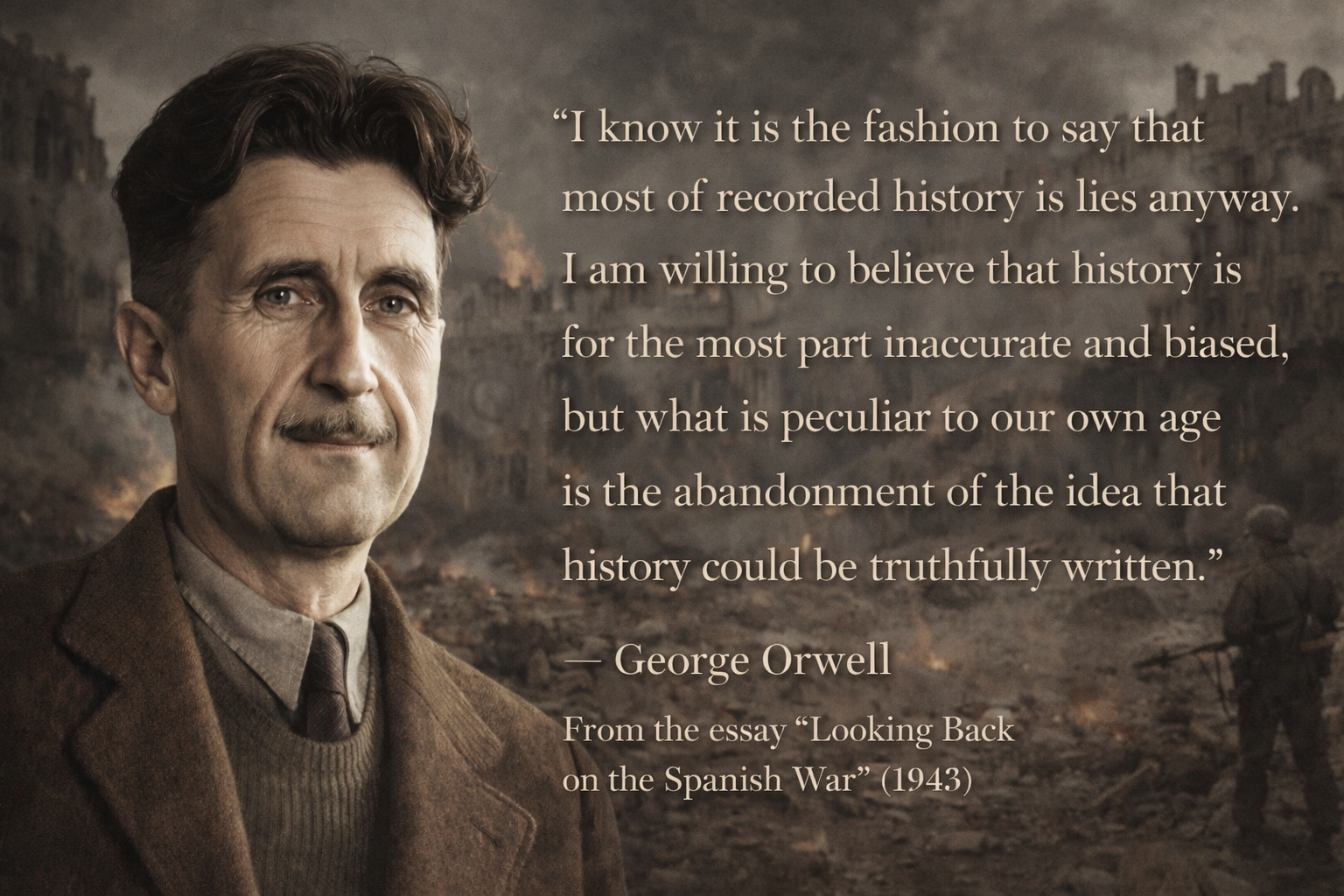
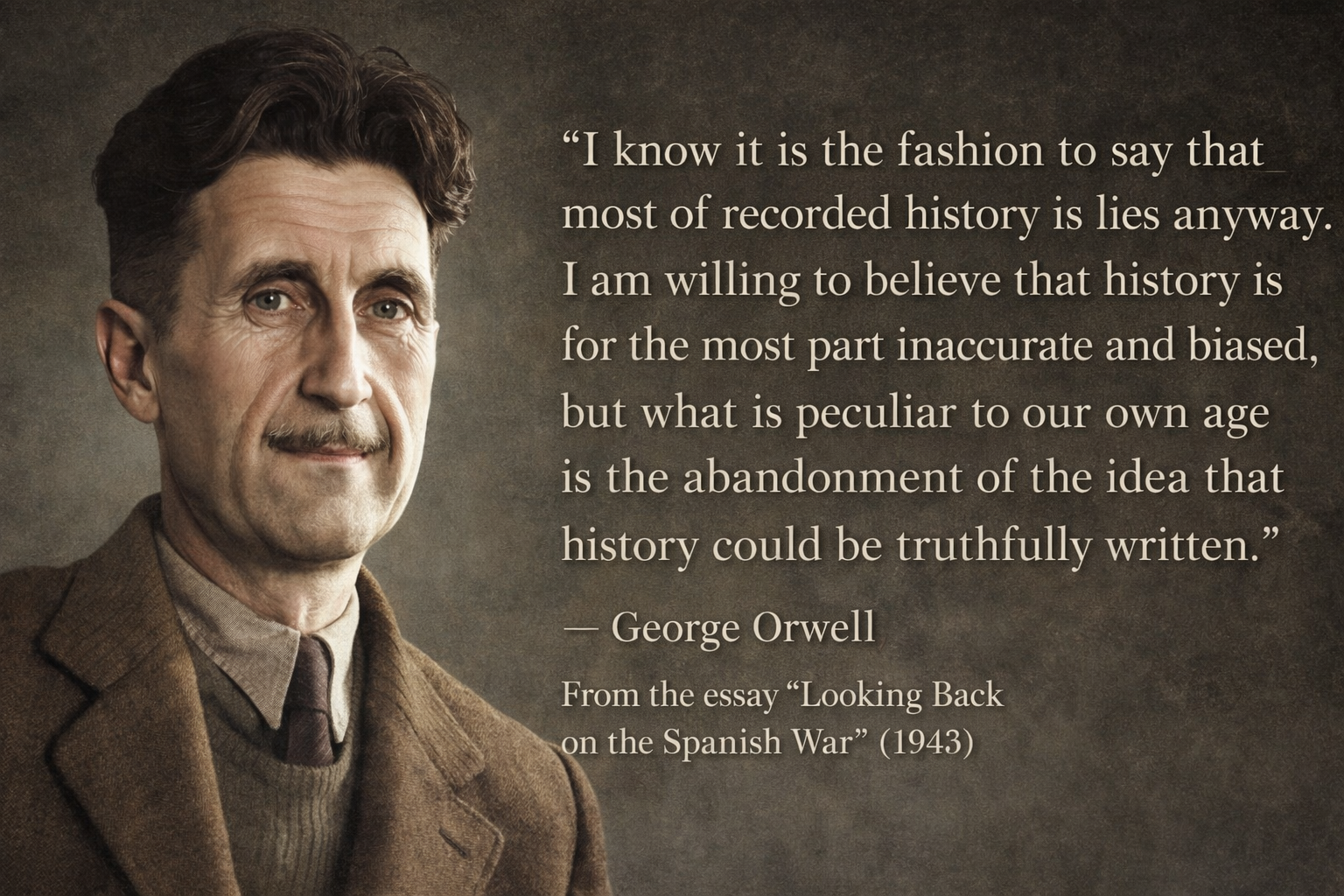
"I know it is the fashion to say that most of recorded history is lies anyway. I am willing to believe that history is for the most part inaccurate and biased, but what is peculiar to our own age is the abandonment of the idea that history could be truthfully written."

— George Orwell, Looking Back on the Spanish War (written 1942; published 1953)

Analytical Interpretation

Background and Context

Orwell wrote this looking back on a war he had fought in body — the Spanish Civil War, where he served with the POUM militia and took a fascist bullet through the throat. What radicalized his sense of truth, though, was not the fighting but the reporting. He watched the London press describe battles that had never happened, recast massacres as victories, and quietly delete real events to fit a political line — accounts governed by which side a paper favored, not by what had occurred. Composed around 1942, in the shadow of a second and larger war, the essay speaks from inside the maturing totalitarian moment of Hitler and Stalin, each of whom rewrote the past as a matter of state policy. The alarm here is precise: not that history is biased — it always was — but that his age had begun to abandon the belief that a truthful history was even the goal.

Interpretation

The whole passage turns on a distinction between two very different failures. The first is fallibility — history "inaccurate and biased," slanted by selective memory, culture, and power. Orwell concedes this without a fight; he is "willing to believe" it. His alarm is reserved entirely for the second failure: the abandonment of the idea that truthful history is possible at all. The continuation of the essay makes the mechanism explicit. In earlier ages, he writes, liars and biased chroniclers still "believed that 'facts' existed and were more or less discoverable." That shared belief in a discoverable reality is the load-bearing beam. Bias operates within a common frame — one distorted account can be measured against the record and corrected. What Orwell sees dying is the frame itself. Notice, too, the word he reaches for at the very top of the passage: he calls the cynical view "the fashion," not the truth — a first move that concedes the surface claim (history is often lies) while quietly refusing the intellectual posture built on top of it. He is not disputing that the diagnosis is common; he is disputing what people have decided to do with it, treating a shrug as though it were an argument.

The key move is the gap between distortion and the denial that there is anything to distort. A biased history can be argued with, because both parties still appeal to a reality that is supposed to exist underneath the disagreement. But an account produced by a system that denies the record cannot be corrected, because there is no agreed ground left to appeal to — only power deciding what happened. The Stalinist practice of airbrushing purged officials out of official photographs and encyclopedia entries is the literal, physical version of this claim: the falsified image does not out-argue the historical record, it tries to become the only record left standing, foreclosing comparison rather than losing it. This is why the passage builds toward Orwell's most-quoted line, that "the very concept of objective truth is fading out of the world." His fear is not for accuracy; it is for truth as a category worth pursuing at all.

The paradox sharpens the point. Perfect objectivity was never actually available to any historian — Orwell knew that. The situation resembles the way scientific method treats truth: no single experiment delivers final certainty, yet the discipline functions only because researchers proceed as though a mind-independent answer exists, waiting to be approximated more closely over time. Remove that regulative assumption and what is left is not modest uncertainty — it is naked assertion, where whoever publishes last, or loudest, simply wins the field. Yet the pursuit of it, the regulative fiction that facts exist and can be sought, is precisely what made history a discipline rather than propaganda. Strip the pursuit away and you do not arrive at some honest, humble relativism. You arrive at the Party deciding what is true. This is the seed of 1984's "who controls the past controls the future" — and the crucial insight is the sequence. The control of the future becomes possible only after the belief in a knowable past has already been surrendered. The tyranny does not begin with the lie; it begins with the shrug that says there was never anything but lies.

Current Relevance

The vocabulary has changed and the diagnosis has not. "Post-truth," "alternative facts," algorithmic feeds that sort us into sealed realities, the sophisticated-sounding claim that "all history is political anyway" — each is a local dialect of the abandonment Orwell named. His distinction is the exact tool the moment needs, because the modern danger is rarely naked lying. It is the slide from a true premise — everyone carries bias — to a false and convenient conclusion: therefore nothing is true, and any inconvenient record is "just another narrative." Once that move is granted, the past belongs to whoever has the loudest platform.

The mechanism now has a name Orwell lacked: "flooding the zone." Rather than argue that a documented event didn't happen, the modern operator simply produces enough competing, contradictory versions that the audience gives up trying to adjudicate between them — exhaustion does the work bias used to do alone. Recommendation algorithms accelerate the same slide by design: they optimize for engagement, not correspondence to fact, so the "history" a person absorbs is increasingly whatever their feed selected for stickiness rather than what a shared archive would support. Culture-war fights over how founding documents, colonial conquest, or a recent election should be taught are, at root, disputes about whether a settleable fact exists beneath the framing — Orwell's line, replayed with a syllabus instead of a newspaper.

Artificial intelligence raises the stakes from interpretation to evidence itself. When synthetic images, audio, and text make the raw record forgeable, we edge toward exactly the world Orwell feared — one where not only the reading of events but the documentation of them can be manufactured to order. Courts are already confronting this directly: litigants now contest whether video or audio evidence is genuine at all, a question that barely existed a decade ago. The nascent response — provenance-authentication standards like content credentials, forensic detection tools, chain-of-custody metadata — is the technological expression of Orwell's remedy: not a claim that any single account is perfectly objective, but an infrastructure built on the premise that origin and authenticity are discoverable facts worth defending. The remedy he points to is not a naive claim to perfect objectivity, which he never believed in. It is the stubborn civic conviction that facts are discoverable and worth the discovering — that the honest attempt is non-negotiable even when it can never be perfected.

Impact and Legacy

This passage is the essay-form preamble to 1984: the diagnosis Orwell would later dramatize as the Ministry of Truth, the memory hole, and a Party slogan about controlling the past. Scholars of Orwell routinely point to Section IV as the place where the novel's central nervous system first appears in raw, undramatized form — evidence that the fiction was reportage extrapolated forward, not invented from nothing.

Beyond the fiction, it seeded a durable and still-vital line of thought — the defense of truth by people who reject naive objectivism. Its lasting contribution is to have separated two things that public argument relentlessly conflates: acknowledging bias and abandoning truth. Orwell insists the first does not entail the second. That single distinction has armed journalists working under disinformation regimes, historians of Soviet and Nazi atrocity who had to rebuild a documentary record against active state denial, and epistemologists who defend truth as a moral and civic orientation rather than a claim to have achieved neutrality. The line about objective truth "fading out of the world" has become one of his most-cited formulations precisely because each generation recognizes its own moment in it — invoked in debates over Soviet historiography in the 1970s, Holocaust denial in the 1990s, and algorithmic disinformation today, each audience certain the essay was written for them.

Contrasting Views or Controversies

The strongest challenge comes from postmodern and critical theory. Thinkers like Michel Foucault and Hayden White argue that all history is narrative — emplotted, selective, and in service of power — and that the very appeal to "objective truth" masks whose truth is being enforced. From that vantage Orwell can look naive, even complicit: the language of neutral, objective history has itself been wielded by empires to dismiss the accounts of the people they conquered. This is a fair steelman, and Orwell's own essay half-concedes it, granting that chroniclers "unconsciously coloured what they wrote." The anthropologist Michel-Rolph Trouillot sharpens the same charge with a mechanism Orwell never names: silences, he argues, enter the historical record at four separate moments — the making of the source, the assembling of the archive, the retrieval of the fact, and the retrospective assignment of significance. On that account it is not that a later liar corrupts a clean record; whole categories of experience — the enslaved, the colonized, the defeated — are filtered out before the record is ever assembled, so the "facts" Orwell wants defended were never symmetrical to begin with. A related version of the objection is about privilege rather than ideology: the appeal to neutral, discoverable fact has historically been made by whoever already controls the courts, the press, and the university, so "just look at the evidence" can quietly become a demand that the powerless clear a bar the powerful both set and interpret.

But the objection partly misfires, because Orwell never claimed history was objective. He claimed the aspiration to truthfulness must survive. His position is ethical, not metaphysical — honest effort, not achieved certainty. There is also a false binary buried in Orwell's own framing — cynicism versus discoverable fact — when a third option exists: perspectival plurality, in which several documented, evidentially rigorous accounts coexist without collapsing into either a single master narrative or a shrug that nothing happened. A disciplined multiplicity of this kind is not the surrender Orwell fears; it is closer to what Trouillot himself practiced. The genuinely unresolved question is whether belief in discoverable facts is a bulwark against tyranny (Orwell) or itself a technology of it (Foucault). Orwell's rejoinder is empirical and hard to wave away, and it is not confined to one ideology: Stalin's purges, the earliest Holocaust denial, and the Khmer Rouge's erasure of Cambodia's own intellectual class all required the prior premise that no stable record existed to be held accountable against — in each case, the atrocity followed the epistemic collapse; it did not cause it. The regimes that most loudly denied the existence of objective truth were also the most murderous. In his century, it was the abandonment of the aspiration, not the aspiration itself, that built the camps.

Practical Application

  • Individual. Hold the line between "this source is biased" — which invites correction against other evidence — and "so every source is worthless," which is surrender dressed as sophistication. Keep the first; refuse the second. In practice, that means checking a claim against at least one source with no motive to agree with you before repeating it, and noticing when "everyone lies anyway" is being used to excuse laziness rather than describe reality.
  • Journalism and education. Teach primary sources and the discipline of visible correction. Model that admitting an error strengthens a claim to truthfulness rather than dissolving it — the opposite of the regime that can never be wrong. A newsroom or classroom that publishes corrections openly, rather than quietly editing the record, is practicing exactly the discoverable-facts commitment Orwell is defending.
  • Civic and institutional. Treat the shared evidentiary commons — public records, archives, transparent methods, independent verification, chain-of-custody standards for digital evidence — as infrastructure. Its erosion is a security threat, not a culture-war skirmish: a society that cannot agree on what happened last week cannot govern itself, prosecute crimes, or negotiate peace, because none of those functions survive without a shared factual floor.
  • Institutions confronting synthetic media. As fabrication moves from words to images, audio, and video, adopt provenance tools — content credentials, forensic verification, source-chain documentation — before a crisis forces the question. Waiting until a fabricated recording is already circulating is too late to build the verification habit.
  • Personal and relational. The abandonment scales down to a single life. Resist letting the version of events you would prefer quietly overwrite the one that actually happened — in your own memory most of all. The discipline is the same at any scale: notice the moment you're tempted to stop asking what really happened, because that moment, multiplied across a culture, is the one Orwell is describing.

Background on the Author

George Orwell (1903–1950), born Eric Arthur Blair in Bengal to a family administering the British Raj, came to this insight the expensive way. He policed empire in Burma, went down and out in Paris and London, then fought in Spain with the POUM militia — where, after being shot through the throat, he found himself hunted by the Communist faction that was simultaneously erasing the anarchists and the POUM from the war's official record. He set that betrayal down directly in Homage to Catalonia (1938), a book so at odds with the pro-Republican consensus of the British left that it sold poorly on release — his own truthful account was, for years, nearly as unwanted as the truth it defended. That experience, and the press's willing complicity in the erasure, is the direct engine of this passage: he watched a truthful history not merely go unwritten but be actively unwritten, in real time, about events he had witnessed with his own body. His authority here is eyewitness, earned at the cost of his literal voice, and paid for again in the commercial cost of telling it straight. It is in the essays, more than the famous novels, that his plain-style war on cant and euphemism is most exact — and Animal Farm and 1984, written in the failing years before tuberculosis killed him in 1950, are best read as this single insight dramatized to its terminal conclusion.

Perspectives

The Difference Between a Lie and a Shrug

Notice what Orwell is not afraid of. He says it outright — he can live with history that's slanted, inaccurate, biased. He'll grant you all of it. What freezes him is the next thing: the moment a culture stops believing there was ever a real event to get wrong in the first place. That's a colder loss than any single lie, because a lie still pays truth the compliment of hiding from it.

I think about that distinction more than I'd expect to. People revise themselves constantly — soften the exit, sharpen the wound, come out of the story a little kinder or a little more wronged than the facts would hold. I don't mind the editing; we all narrate, it's half of how we survive ourselves. What stops me cold is the other thing — the person who has quietly decided that nothing really happened, that it's all spin anyway, so why not pour whatever version serves the night. That isn't a liar. That's someone who has let the floor go. Orwell watched a whole century get ready to do it, and the frightening part isn't that he was wrong. It's that he was early. The antidote was never pretending we remember cleanly — none of us do. It's refusing to stop reaching for what actually occurred, even when the honest version costs you the better line.

Earlier Analytical Interpretation (2026-01-24)

Background and Context

Written during the Second World War, Orwell's 1943 essay Looking Back on the Spanish War captures a rare moment of disillusionment from a writer who had fought on the front lines and witnessed ideological deception firsthand. The Spanish Civil War (1936–1939), which drew Orwell into its fold, became a microcosm of 20th-century information warfare: propaganda superseded facts, and both sides rewrote history in real time. Orwell's wounds were not only physical—they were epistemological.

This quote is a crystallisation of Orwell's frustration. He accepts that history is often flawed—riddled with selective memory, cultural bias, and the influence of power. But he draws a crucial line: while imperfection is inevitable, the aspiration to write history truthfully must not be abandoned. Orwell believed that without that aspiration, history becomes indistinguishable from manipulation.

Interpretation

Orwell distinguishes between two forms of distortion: fallibility and intentional abandonment. The former is human and forgivable; the latter is corrosive. He is not claiming that the past was ever recorded with pure objectivity. Rather, he identifies a unique degeneration in his own time—the loss of belief that truth even matters.

It is a philosophical diagnosis. The shift Orwell describes is not just a political trend but an ontological rupture: the idea that truth is no longer a category worth pursuing. In prior epochs, even biased chroniclers operated under a pretense of objectivity. But in Orwell's modern age, that pretense collapses—replaced by relativism, factionalism, and the instrumental use of history.

His concern is not with error, but with cynicism—the collective surrender of intellectual integrity. This, to Orwell, is the true danger: not merely that people lie about the past, but that they no longer believe there's such a thing as lying about it.

Current Relevance

Orwell's insight feels more urgent now than ever.

In the age of post-truth politics, algorithmic radicalisation, and revisionist nationalism, the abandonment of factual consensus is no longer theoretical. Debates over what happened last year—let alone decades ago—are now sites of ideological trench warfare. The claim that "all history is political" has become justification for outright fabrication.

This is Orwell's prophecy unfolding: when the idea of truth is seen as naive or elitist, what remains is not a free marketplace of ideas, but a collapse of meaning itself.

From debates over school curricula to misinformation about public events, the contemporary landscape reflects a culture where the ambition to seek truth is optional, and where distortion is often celebrated as resistance.

Impact and Legacy

This quote echoes through Orwell's larger body of work, particularly in 1984, where the manipulation of memory and history is formalised into state doctrine. "Who controls the past controls the future," Orwell would later write—but here we see the preamble: the moment when that control becomes possible, because belief in historical truth has already eroded.

Academically, Orwell's stance has influenced historians, political theorists, and epistemologists who defend truth not as a perfect state but as a civic and moral orientation. His emphasis on intentionality over infallibility has reshaped discussions around historical ethics and the role of media.

This quote has also become a rallying cry for journalists and truth-tellers operating under regimes of disinformation. It captures the essential difference between bias and bad faith—and the stakes of confusing the two.

Contrasting Views or Controversies

Postmodern and critical theorists often challenge Orwell's position by arguing that all history is constructed, and that claims of neutrality mask embedded power structures. Thinkers like Michel Foucault and Hayden White contend that history is narrative, not objective record, and that every account serves a purpose—however disguised.

From this lens, Orwell's concern appears somewhat idealistic, perhaps insufficiently attuned to the structural forces that shape what counts as truth. Yet Orwell does not argue for absolute objectivity; he argues for honest effort. His critique is ethical, not metaphysical.

This tension between Orwell and postmodernism remains unresolved but fertile: it invites us to ask whether aspiring to truth is itself an ideological act—or whether abandoning that aspiration guarantees tyranny.

Practical Application

This quote is a call to vigilance—for historians, educators, journalists, and citizens alike. In an era of contested memory, Orwell urges us to reclaim epistemic responsibility: to distinguish between inevitable bias and willful distortion.

Practically, this means:

  • Teaching students to engage with primary sources, not just interpretations
  • Defending journalistic integrity, especially under political pressure
  • Designing algorithms and information systems that reward evidence, not engagement
  • Cultivating a culture that treats honest disagreement as a sign of strength, not treason

In short, Orwell reminds us that while perfection is impossible, the pursuit of truth is non-negotiable.

Background on the Author

George Orwell (1903–1950), born Eric Arthur Blair, was a British novelist, journalist, and essayist renowned for his fierce defense of clarity, honesty, and intellectual freedom. A democratic socialist with an anti-authoritarian streak, Orwell fought with the POUM militia in the Spanish Civil War—an experience that profoundly shaped his worldview.

His most influential works, Animal Farm and 1984, are enduring critiques of propaganda, surveillance, and totalitarianism. But it is in his essays—sharp, lucid, and morally uncompromising—that Orwell's voice is most precise. He distrusted cant, euphemism, and the soft corruption of thought by language.

What defined Orwell was not ideological purity but moral clarity—the willingness to call things by their true names, even when doing so was dangerous or unfashionable.
Additional Images

Images generated (unless otherwise noted) by ChatGPT-5.2, OpenAI, 24 January 2026, from the prompt: "Generate a single banner for the quote. Use image generation (not image_group, carousels, or image search). Treat the banner as a designed editorial artifact, not an illustration. Use a contextually suitable background from the Spanish War (added for second generation). Required format: horizontal (~16:9). Split composition: left, a photorealistic, historically accurate author portrait. Right: the full quote on dark/neutral background with author name. Clean, restrained typography. No logos, watermarks, cartoons, or sketches. Fallback if a real-person image is not permitted or unavailable, generate a neutral, photorealistic thematic banner."

Quote captured 28 August 2025.

Provenance — researched 2026-07-02
  • Attributed to: George Orwell (Eric Arthur Blair) — the passage is his own analytical/essayistic voice, not a quoted character.
  • Source: "Looking Back on the Spanish War," Section IV; collected in England Your England and Other Essays (London: Secker & Warburg, 1953).
  • Date & context: Written c. 1942, in the aftermath of Orwell's service with the POUM militia in the Spanish Civil War (1936–1939) and his narrow escape from the Communist suppression of the POUM/anarchist record. Section IV was not among the portions (Sections I–III and VII) that first appeared in the journal New Road (London) in 1943; it reached print only with the essay's full posthumous publication in 1953. The filed "1943" is defensible as the essay's first-publication year overall but imprecise for this specific passage; the readable citation reflects writing (1942) and full publication (1953).
  • Verified wording: "I know it is the fashion to say that most of recorded history is lies anyway. I am willing to believe that history is for the most part inaccurate and biased, but what is peculiar to our own age is the abandonment of the idea that history could be truthfully written." The filed text is correct word-for-word and in punctuation; one detail restored — Orwell italicizes could, and that emphasis has been restored to the block quote. For context (not part of the filed quote), the passage continues: "In the past people deliberately lied, or they unconsciously coloured what they wrote, or they struggled after the truth, well knowing that they must make many mistakes; but in each case they believed that 'facts' existed and were more or less discoverable" — building to Orwell's much-quoted line, "the very concept of objective truth is fading out of the world."
  • Status: Authentic — genuine Orwell, faithfully attributed and quoted, with the italic emphasis on could restored. Verified against the standard collected editions — England Your England and Other Essays (1953), Collected Essays (1961), and The Collected Essays, Journalism and Letters of George Orwell, ed. Sonia Orwell and Ian Angus (1968) — all identical in wording, and reproduced consistently across the Orwell Foundation, orwell.ru, and libcom primary-text archives. Caveat: the page range in the citation below is the customary one for the 1953 edition, not verified against a physical copy; the 1942-vs-1943 writing date is genuinely contested across sources, though the New Road 1943 / full-essay 1953 publication facts are firm.
  • Citation (Chicago):
    • Orwell, George. "Looking Back on the Spanish War." 1942. In England Your England and Other Essays, 133–158. London: Secker & Warburg, 1953. First partial publication in New Road (London), 1943.

Provenance researched 2026-07-02.

AI-assisted interpretive essays, each gated by a mechanical provenance and image-eligibility check before publishing.