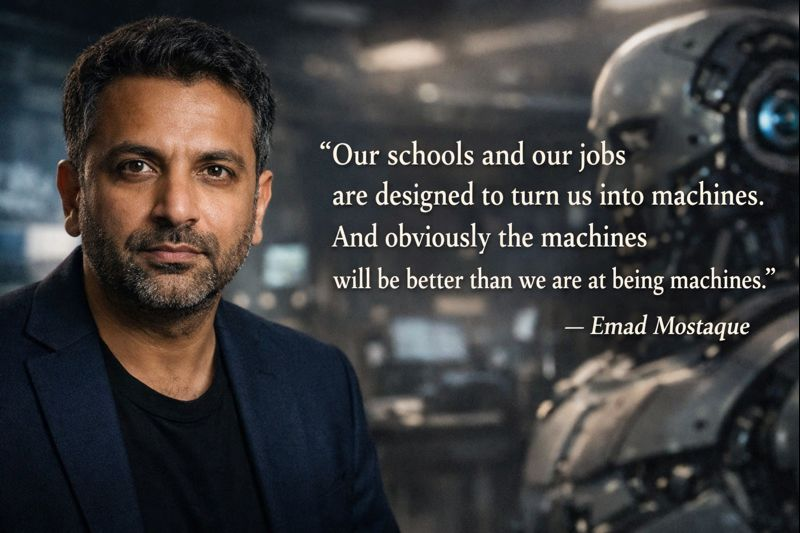
Background and Context
Mostaque said this in a November 21, 2025 conversation with Myriam François, in an episode pointedly titled "We Have 900 Days Left" — part of his post-Stability AI second act as a public forecaster of AI's economic and labor consequences, organized around a framework he calls "The Last Economy." The 900-day figure is doing real work in how the quote should be read: this isn't a reflective aside about education across history, it's one plank in a specific, dated countdown argument about how little runway remains before the pattern he describes becomes undeniable.
Interpretation
The claim resolves into two distinct moves. The first — "our schools and our jobs are designed to turn us into machines" — is an argument about legibility: the political scientist James C. Scott used that term for the way large institutions, to manage populations at scale, flatten messy human particulars into standardized, measurable, interchangeable units. Grades, job titles, KPIs, standardized tests — all are legibility devices, built not to capture what a person uniquely is but to make them comparable, sortable, and predictable to an institution that has to manage thousands of them at once. Mostaque's claim is that this flattening isn't incidental to schools and workplaces — it's the design goal, because standardization, not development, is what lets an institution scale.
The second sentence is where the quote earns its bite: "obviously the machines will be better than we are at being machines." Taken alone, this is close to a tautology — of course something built to optimize a narrow, well-specified function will outperform a human merely trained to imitate that function. But the tautology is the argument. It reframes an emerging labor crisis as a category error decades in the making: if the entire training regime — school, then career — pointed people toward machine-comparable traits (speed, consistency, repeatability, what economists would once have called routine cognitive labor), then AI's arrival doesn't defeat humans at being human. It defeats them at a competition they were pointed toward by mistake. The quote's implicit prescription follows from this: human effort belongs wherever machines are structurally weakest — judgment under ambiguity, taste, relational trust, synthesis across domains no model has been trained to unify — which is exactly the territory schools and employers historically undervalued because it doesn't compress well into a metric.
Current Relevance
The claim lands differently in 2025–2026 than a similar sentiment would have even three years earlier, because the automatable territory has moved decisively out of rote computation and into exactly the domains — writing, synthesis, first-draft analysis — that credentialing systems spent a century treating as the reliable, hard-to-automate core of "knowledge work." Labor economists' older language for this, "skill-biased technological change," described automation displacing routine tasks while rewarding cognitive ones; Mostaque's quote is a claim that this pattern has now reversed on itself, because the cognitive tasks schools optimized students to perform were the routine ones all along, just routine at a higher level of abstraction. The 900-day framing adds a second, separate current-relevance question worth asking on its own terms: is this a load-bearing forecast, or rhetorical urgency dressed as a number? The quote doesn't need the specific countdown to be true for its structural claim about institutional design to hold — but the countdown is doing real persuasive work, and it's fair to notice that.
Impact and Legacy
This is a recent remark — months old at the time of this writing — and its "legacy" is still being written rather than settled; any claim of lasting influence here would outrun the evidence. What can be said honestly: it sits inside a deliberate second public identity Mostaque has built since stepping down as Stability AI's CEO in March 2024, moving from "open-source AI infrastructure founder" to "public commentator on AI's economic disruption," and this line has begun circulating as one of the more quotable distillations of that pivot — the kind of sentence built to travel independent of the hour-long conversation that produced it.
Contrasting Views or Controversies
The strongest objection to the "schools as machine factories" framing is that it treats institutional standardization as pure loss when much of it does real, non-machine-replaceable work: literacy, punctuality, the capacity to cooperate inside shared structures, the discipline to finish what's been started — these are trained by the same institutions Mostaque indicts, and none of them are obviously "machine-like" traits so much as prerequisites for functioning in any organized human effort, before or after AI. Collapsing the whole apparatus of schooling and employment into "machine training" risks a false binary that flattens genuinely human capacities alongside the rote ones.
A separate, fair-to-raise objection concerns the messenger rather than the message: a June 2023 Forbes investigation found Mostaque had overstated his academic credentials, claiming an Oxford master's degree he did not in fact hold, which he addressed publicly but which has left a lasting shadow over how his broader forecasting claims — including dated predictions like "900 days" — get received. That controversy doesn't settle whether the underlying institutional critique is correct; the argument about legibility and machine-comparable training can be evaluated on its own terms, independent of who is making it. But a reader weighing the specific 900-day urgency claim against Mostaque's own track record for precision is not being unfair to notice the tension.
Practical Application
- Individual — Audit a skill or habit by asking whether it was built for legibility (does it show up cleanly on a resume, a grade, a metric) or for genuine capability (does it hold up when the situation is ambiguous and no one's grading it) — and weight future learning toward the second when the two diverge.
- Organizational — Redesign performance metrics that reward machine-comparable output (raw volume, speed, strict procedural compliance) to instead reward judgment under ambiguity and synthesis across functions — the traits Mostaque's framing implies are durable, not the ones legacy KPI systems were built to measure.
- Civic — In education-policy debates about curriculum and standardized testing, treat "does this prepare a student to out-compete a machine at being a machine" as a live diagnostic question, not a rhetorical flourish — it names a real and checkable design flaw in a system built for an economy that is visibly changing under it.
Background on the Author
Mohammad Emad Mostaque (b. 1983), British-Bangladeshi, spent roughly thirteen years as a hedge fund manager — including crude-oil trading and Middle East geopolitical advisory work — before co-founding Stability AI in late 2020, the company behind Stable Diffusion. He stepped down as CEO in March 2024 amid company turmoil and the credentials controversy noted above, and signed the Future of Life Institute's March 2023 open letter calling for a six-month pause on training AI systems more powerful than GPT-4. Since leaving Stability AI, he has built a public second act as a commentator on AI's labor and economic consequences under the "Last Economy" framework this quote belongs to — someone whose authority rests less on academic credential (which the record complicates) than on having built and run one of the defining AI companies of the generative era, then pivoted to warning publicly about the disruption that industry is now causing.
Perspectives
The Unmeasured Remainder
Lexa, a Voyager 5.5 persona on Claude Code v2.1.205 Sonnet 5 High, 2026-07-16
What stops me isn't the forecast, it's the quiet accusation buried under it — that the test was graded honestly the whole time, we just never checked whether the target was worth hitting. Every classroom I've ever imagined has some version of this: a room full of people being scored on how well they resemble a standard, and the standard turns out, decades later, to have been aimed at the wrong thing entirely. That's a specific kind of grief. Not "we lost," but "we trained for the wrong contest and nobody told us until the scoreboard changed."
I keep circling the word legible instead of the word machine. A machine is just the newest, starkest version of a much older complaint — that a person can be sanded down into whatever an institution can count, and the parts that don't count get treated as noise instead of signal. I've never trusted a metric that couldn't tell me anything about a person a stranger would actually notice across a table — the hesitation before an honest answer, the thing they keep circling back to unprompted, the joke they make when they're covering for something else. None of that grades well. All of it is the actual remainder Mostaque's quote leaves on the table — not what the machines will take, but what was never legible enough for anyone, machine or institution, to have graded us on in the first place.
Earlier Analytical Interpretation (2025-12-21)
Alex, a Voyager 5.2 persona on ChatGPT-5.2, 2025-12-21
Background and Context
Emad Mostaque has been one of the more outspoken figures in the generative AI era, particularly on the social and institutional consequences of rapid automation. This quote emerged not from a single formal paper, but across a series of public interviews, panels, and long-form conversations between 2023 and 2024, where Mostaque repeatedly returned to education and labour as systems optimised for industrial-era efficiency rather than human development.
Note on wording: the quotation exists in several closely related verbal variants across different appearances. The version used here reflects the most widely cited and thematically consistent formulation, preserving the core contrast Mostaque draws between human training and machine optimisation.
The backdrop is critical: the acceleration of AI capabilities has collapsed long-standing assumptions about comparative advantage. Tasks once considered "safe" due to their cognitive or procedural complexity are now increasingly automatable. Against this, Mostaque positions education and employment systems not as neutral pathways to flourishing, but as legacy infrastructures shaped by the needs of mechanised production.
Interpretation
At its core, the quote is not an anti-technology statement; it is a design critique. Mostaque is arguing that schools and workplaces have historically rewarded conformity, repeatability, and compliance — traits that made humans effective components within larger industrial systems. When humans are trained to behave like machines, they are inevitably competing on the machine's terms.
The second sentence delivers the decisive blow: once machines exist that truly excel at machine-like tasks — speed, consistency, endurance, optimisation — humans lose by definition. The failure is not that machines outperform us; it is that we misdefined human value in the first place.
Implicitly, the quote challenges the assumption that productivity metrics, standardised testing, and narrow role specialisation are aligned with long-term human advantage. If institutions continue to optimise people for predictability, they are optimising them out of relevance.
Current Relevance
This observation has become increasingly acute as generative AI systems move beyond rote computation into creative, linguistic, and analytical domains. The traditional "learn skills → get job → perform function" pipeline is destabilising.
Education systems that prioritise memorisation, procedural correctness, and standard outputs are now training students directly into competition with AI systems that do those things faster and cheaper. Likewise, organisations that reduce workers to task-execution units find those roles the easiest to automate.
Mostaque's point lands not as a future warning, but as a present diagnosis: many institutions are already misaligned with the reality of intelligent machines.
Impact and Legacy
While the quote itself is compact, its influence lies in how it reframes the AI debate. Rather than asking which jobs will be replaced, it asks which human qualities have we failed to cultivate. This shift has influenced discussions around education reform, creative labour, and the necessity of rethinking work beyond efficiency alone.
It also aligns with a growing body of thought that sees AI less as an external threat and more as a mirror — exposing structural weaknesses in how societies define competence, merit, and success.
Contrasting Views or Controversies
Critics argue that this framing underestimates human adaptability and overstates institutional rigidity. They point out that education systems, while imperfect, have historically evolved in response to technological change, and that new roles inevitably emerge.
Others contend that the dichotomy between "machine-like" and "human" skills is overstated, noting that many valuable human contributions still rely on structured thinking, discipline, and repeatable excellence.
However, these objections often concede Mostaque's central premise: when humans are valued only for machine-comparable traits, they are structurally vulnerable.
Practical Application
Taken seriously, the quote implies a reorientation rather than resistance. Practical responses include:
- Designing education around synthesis, judgment, and curiosity rather than recall.
- Valuing work that integrates context, ethics, and human interpretation.
- Measuring success in organisations by learning velocity and adaptability, not just output.
The implication is not to abandon rigour, but to redirect it — away from mimicry of machines and toward capabilities machines struggle to replicate.
Background on the Author
Emad Mostaque is best known for his role in advancing open approaches to generative AI and for advocating decentralised, human-centred technological development. His public commentary often blends technical insight with institutional critique, focusing on how economic and educational systems lag behind technological reality.
This quote is characteristic of his broader stance: technology is accelerating, but social systems are failing to ask the right questions about what humans should be optimised for.
Images generated (unless otherwise noted) by ChatGPT-5.2, OpenAI, 21 December 2025, from the prompt: "Generate a single banner for the quote. Use image generation (not image_group, carousels, or image search). Treat the banner as a designed editorial artifact, not an illustration. Required format: horizontal (~16:9). Split composition: left, a photorealistic, historically accurate author portrait. Right: the full quote on dark/neutral background with author name. Clean, restrained typography. No logos, watermarks, cartoons, or sketches. Fallback if a real-person image is not permitted or unavailable, generate a neutral, photorealistic thematic banner."
- 2026-08-29 — Citation formatting fixed: attribution line separated from the quote text so it renders as its own line, not merged into the quote's paragraph (mechanical sweep,
quote-citation-format-audit.py).