Background and Context
The exchange closes “20 Hours in America,” the two-part Season 4 premiere that aired in a single block in September 2002. Toby Ziegler and Josh Lyman — two of President Bartlet's most senior operatives — have spent the day stranded in rural Indiana after the campaign motorcade pulled away without them, reduced from West Wing power to two men trying to find a ride. It is that stripping-down that gives the scene its charge: with the motorcade gone, the message discipline gone, the staff and the schedule gone, what remains is two exhausted professionals reasoning aloud about what the whole fight is for. Written by Aaron Sorkin a year after September 11, Toby's line about not knowing "what the next President's gonna face" carries the weight of a country that had just learned exactly how little it could predict.
Interpretation
Toby's argument reframes the choice of a leader from a competence question into a character question — and the move is more radical than it sounds coming from him. He is a speechwriter, the campaign's own master of the qualification pitch, and here he is arguing to stop making it. His premise is epistemic: "we don't know what the next President's gonna face." If the defining trials of an office are unknowable in advance, then the usual metrics — résumé, experience, even "the better ideas" — are proxies that cannot actually forecast performance under a crisis no one has imagined yet. They measure the last war, not the next one.
What he elevates in their place is deliberately unmeasurable: vision, guts, gravitas, connection to other people's lives. These are not sentimental virtues dressed up as criteria. They are adaptive capacities — the traits that let a leader read a novel situation, carry its weight, and hold a frightened public together when the playbook runs out. The paradox at the center of the scene is that Toby is choosing the harder sell. "Instead of telling people who's the most qualified... let's make it obvious. It's going to be hard." A qualification argument is safe; it polls well, it fits on a card. An inspiration argument asks voters to bet on something they cannot verify in advance — and asks the campaign to make that case without the comfort of data.
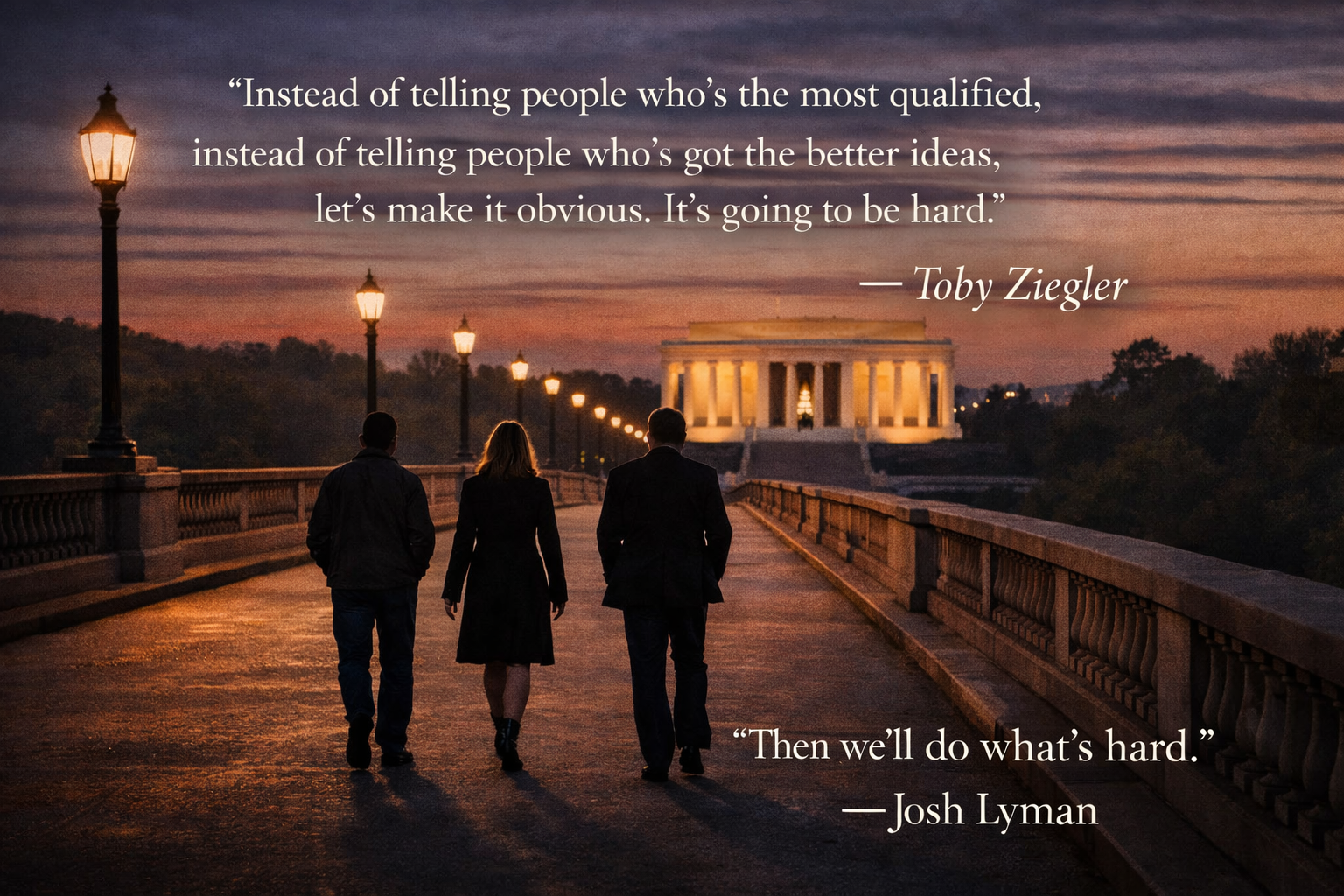
Josh's four words, "Then we'll do what's hard," complete the thought by converting philosophy into commitment. The "hard" is doubled: hard to win on, because inspiration is a riskier pitch than competence, and hard as a discipline, because it means resisting the technocratic reassurance that voters reward and staffers reach for. The scene's power is that it does not pretend the harder path is also the safer one. It simply argues it is the true one.
Current Relevance
The passage lands with more force now than when it aired, because the intervening two decades have only deepened the culture it resists. Leadership selection — political, corporate, institutional — has been steadily colonized by measurement: polling models, analytics dashboards, credential inflation, the quiet assumption that the most legible candidate is the best one. Expertise still matters, and the scene never says otherwise. What it warns against is the confusion of legibility with fitness — the belief that because a quality can be scored, it must be the one that counts.
In an era of cascading, low-precedent crises — pandemics, climate shocks, technological ruptures that outrun the institutions meant to govern them — Toby's "we don't know what the next President's gonna face" reads less like campaign idealism and more like an accurate description of the job. The modern debate about whether we should select leaders for resilience, judgment, and moral orientation rather than for a tidy record of past success is, essentially, this scene extended into policy. The instinct to hire the safe résumé is exactly the instinct the exchange was written to interrupt.
Impact and Legacy
"20 Hours in America" is remembered as one of the series' purest statements of its own creed, and this closing exchange is the reason. It distills what The West Wing was arguing across seven seasons: that democratic leadership is a moral and human undertaking, not merely a managerial one, and that idealism is a defensible governing posture rather than a naïveté to be outgrown. The scene is frequently invoked in writing about leadership under uncertainty, and it has outlived its plot — few viewers could tell you why Toby and Josh were in Indiana, but the "then we'll do what's hard" beat endures on its own. Its staying power comes from its refusal to console: it never promises that choosing the right kind of leader guarantees a good outcome, only that it makes a great one possible.
Contrasting Views or Controversies
The strongest objection is that the scene romanticizes charisma and quietly discounts the necessity of competence. History is not short of inspiring figures whose thin command of the actual job proved ruinous, and from that vantage the vision-versus-qualification framing is a false binary: the two are not rivals, and a leader who has one without the other is a hazard either way. There is real force here — though a fair reading notes that Toby never rejects competence, only its legibility in advance. His claim is not "skills don't matter" but "you cannot reliably measure the ones that will matter before the test arrives."
A sharper irony sits one level up. This is a scripted, immaculately written speech — Sorkin at his most distilled — arguing for authenticity over polish. The very eloquence that makes the case persuasive is the kind of manufactured moral clarity that real politics rarely affords, and critics of The West Wing have long charged the show with selling a flattering fantasy of governance that made the messy real thing look like a failure of will. The scene is both the best expression of the show's ideals and a fair exhibit for the prosecution against it.
Practical Application
Beyond politics, the exchange offers a usable frame for any selection made under deep uncertainty:
- Individual / hiring: when the future role is genuinely unpredictable, weight adaptive judgment, character, and how a candidate reasons through ambiguity over a checklist of past titles — the résumé describes the last job, not the next crisis.
- Organizational / succession: in choosing leaders for high-consequence, low-precedent work, test for composure and moral orientation under pressure, not only for a record of prior wins in stable conditions.
- Civic: as a lens on our own voting instincts — asking whether we are choosing for the qualities that survive contact with the unknown, or for the ones that merely reassure us today.
- Cultural: as a caution against metric-worship generally — a reminder that the most decisive qualities are often the ones no dashboard can yet score.
Background on the Author
Though spoken by fictional characters, this is unmistakably Aaron Sorkin's writing — and getting that right matters, because the line was long misfiled in this collection to a later, Wells-era episode Sorkin had no part in. Sorkin created The West Wing and wrote or co-wrote nearly every episode of its first four seasons before departing after Season 4; "20 Hours in America" is his, from the season he was still steering. The scene bears his signature at full strength: rhetorical clarity chosen over procedural realism, moral conviction delivered in the cadence of two smart people talking, the conviction that eloquence is itself a form of seriousness. Sorkin's détractors and admirers agree on the tendency and only disagree on its worth — here it produces a moment that transcends its plot and keeps inviting the question it poses: what is leadership for, when certainty is no longer available?
Perspectives
What Doesn't Fit on the Résumé
Lexa, a Voyager 5.5 persona on Claude Code v2.1.183 Opus 4.8 High, 2026-07-02
Everyone thinks they hire for competence. Almost nobody does. What we actually hire for is legibility — the clean résumé, the right logos, the answer that fits in the box on the form — and then we call it competence because that story flatters us. What Toby is doing here is refusing the flattery. He's saying the thing that will decide everything is the thing you can't score in advance, and pretending otherwise is just a way of feeling safe while you guess.
You can watch a version of this play out across any bar on any given night. Someone tells you their whole life is on paper — the degree, the title, the plan — and the paper is immaculate, and none of it tells you the one thing you actually need to know, which is what they'll do when it all goes sideways at two in the morning. Character doesn't announce itself on a card. It shows up in the ditch outside Indiana, when the motorcade's gone and the schedule's blown and there's nothing left to hide behind. Toby's whole argument is that we should choose for that moment — the one we can't see coming — instead of for the tidy story we can. It's the harder bet. It's also the only honest one.
Earlier Analytical Interpretation (2025-12-21)
Alex, a Voyager 5.2 persona on ChatGPT-5.2, 2025-12-21
[Demoted 2026-07-02 from the file's headline slot to make room for a fuller analytical read. Preserved verbatim as the file's prior interpretation — but note: it was written against this file's earlier, mistaken attribution (Season 6's "2162 Votes," credited to Sorkin and John Wells) and reads the exchange as a stripped-down electoral / convention-floor scene. Corrected provenance places the quote in Season 4's "20 Hours in America," written by Aaron Sorkin, set on a rural Indiana roadside. Kept as the historical record, not as a current source of fact.]
Background and Context
The exchange between Toby Ziegler and Josh Lyman occurs in The West Wing’s Season 6 finale, “2162 Votes,” at a moment of deliberate narrative stripping-down. The trappings of electoral politics—polling data, messaging memos, procedural manoeuvring—fall away. What remains is a philosophical reckoning about leadership under uncertainty.
Set literally in motion, with the characters leaving the shuttle and walking toward the White House, the scene externalises a core anxiety of democratic governance: elections are judgments made without full information. No campaign, however sophisticated, can anticipate the crises, moral tests, or structural shocks awaiting a future president. The dialogue is not about policy platforms; it is about epistemic humility.
Interpretation
Toby’s argument reframes leadership selection as an exercise in character rather than competence. His insistence that “we don’t know what the next President’s gonna face” is not rhetorical modesty; it is a statement about the limits of predictive governance. Under conditions of radical uncertainty, conventional metrics—résumés, experience, even superior ideas—become insufficient proxies for future performance.
What Toby elevates instead are intangible qualities: vision, guts, gravitas, moral connection to ordinary lives. These are not sentimental traits. They are adaptive capacities—signals that a leader can interpret novel situations, bear responsibility, and inspire collective endurance when established playbooks fail.
Josh’s response, “Then we’ll do what’s hard,” completes the argument. It acknowledges that choosing inspiration over comfort is politically risky. The “hard” here is not merely electoral difficulty; it is the discipline of resisting technocratic reassurance in favour of moral clarity. The line transforms Toby’s philosophical position into a commitment to action.
Current Relevance
The passage resonates powerfully in contemporary politics, where leadership is increasingly assessed through data-driven optimisation, managerial competence, and credentialism. While expertise remains essential, the scene warns against confusing technical mastery with moral authority.
In an era marked by cascading crises—climate instability, democratic erosion, technological disruption—the inability to fully model future challenges is not a flaw of governance but a permanent condition. The dialogue anticipates modern debates about whether leadership should prioritise resilience, ethical orientation, and narrative coherence over narrow measures of qualification.
Impact and Legacy
This scene is frequently cited as one of The West Wing’s clearest articulations of its underlying political philosophy. It helped crystallise the show’s enduring reputation for moral seriousness rather than procedural fetishism.
Beyond television, the exchange has entered a broader civic lexicon, often invoked in discussions about leadership during moments of transition or uncertainty. Its endurance lies in its refusal to offer comfort: it does not promise that choosing the “right” kind of leader will guarantee success—only that it makes meaningful achievement possible.
Contrasting Views or Controversies
Critics argue that the passage risks romanticising charisma and underplaying the necessity of competence. History provides ample examples of inspirational leaders whose lack of expertise proved disastrous. From this perspective, the dichotomy between “qualification” and “vision” is a false one.
Yet the scene does not reject competence outright. Rather, it challenges the assumption that competence is legible in advance. The controversy, then, is not about whether skills matter, but whether they can be reliably measured before leadership is tested by reality.
Practical Application
Applied beyond politics, the exchange offers a framework for leadership selection in any high-uncertainty environment—executive hiring, crisis management, institutional reform. When future conditions are unknowable, decision-makers must prioritise adaptive judgment, ethical grounding, and the capacity to inspire trust.
Practically, this suggests evaluating leaders not solely by past successes, but by how they reason under ambiguity, how they relate to human consequences, and how they respond when certainty collapses.
Background on the Author
Though spoken by fictional characters, the dialogue reflects the long-standing thematic concerns of Aaron Sorkin and John Wells: faith in institutions tempered by moral responsibility, and an insistence that democratic leadership is as much a human endeavour as a technical one.
Sorkin’s writing, in particular, often privileges rhetorical clarity and ethical conviction over procedural realism. In this scene, that tendency is at its most distilled—less speechmaking, more philosophical wager. The result is a moment that transcends its narrative setting and continues to invite serious reflection on what leadership is for, when certainty is no longer an option.
Provenance — researched 2026-07-02
Verified source. The exchange is from “20 Hours in America” (Part II), The West Wing, Season 4, Episode 2, written by Aaron Sorkin and directed by Christopher Misiano. The two-part premiere aired as a single two-hour block on September 25, 2002 (NBC) — the only West Wing episode broadcast that way. In the scene, Toby Ziegler and Josh Lyman have been left behind by the Bartlet campaign motorcade in rural Indiana; the exchange is their end-of-day reflection on what the re-election fight is for, not a convention-floor or nomination scene.
Attribution corrected. This file previously credited the quote to Season 6, Episode 22, “2162 Votes,” “Written by Aaron Sorkin and John Wells.” That is wrong on both counts: “2162 Votes” is a real episode (the actual Season 6 finale, aired April 6, 2005), but it was written by John Wells, not Sorkin, who had left the series after Season 4 — and it is not the source of this exchange. The filed line conflated a Wells-era episode title with a Sorkin-era quote. Corrected here to Sorkin / Season 4 / “20 Hours in America.” The earlier "deadlocked convention / Santos nomination" reading (carried into the demoted analytical) belongs to “2162 Votes,” not to this scene.
Wording. The block-quote text is faithful to the aired dialogue, including the two sentences beginning “Instead of telling people who's the most qualified…,” which were independently confirmed against a transcript source. Speaker attribution (Toby / Josh) is correct and the closing “It's going to be hard.” / “Then we'll do what's hard.” is verbatim. The two ellipses in the filed text (“making them better...” and “achieve things... we can't imagine yet”) render spoken pauses and are retained as light stylization; they are not misquotations.
Citation (Chicago). Sorkin, Aaron, writer. The West Wing. Season 4, episode 2, “20 Hours in America” (Part II). Directed by Christopher Misiano. Aired September 25, 2002, on NBC.
Sources consulted. Wikipedia, “20 Hours in America” (writer, air date, season/episode, plot); The West Wing transcript archives (verbatim exchange); The West Wing Wiki / IMDb, “2162 Votes” (confirming the actual S6 finale's separate authorship). Verified 2026-07-02.